
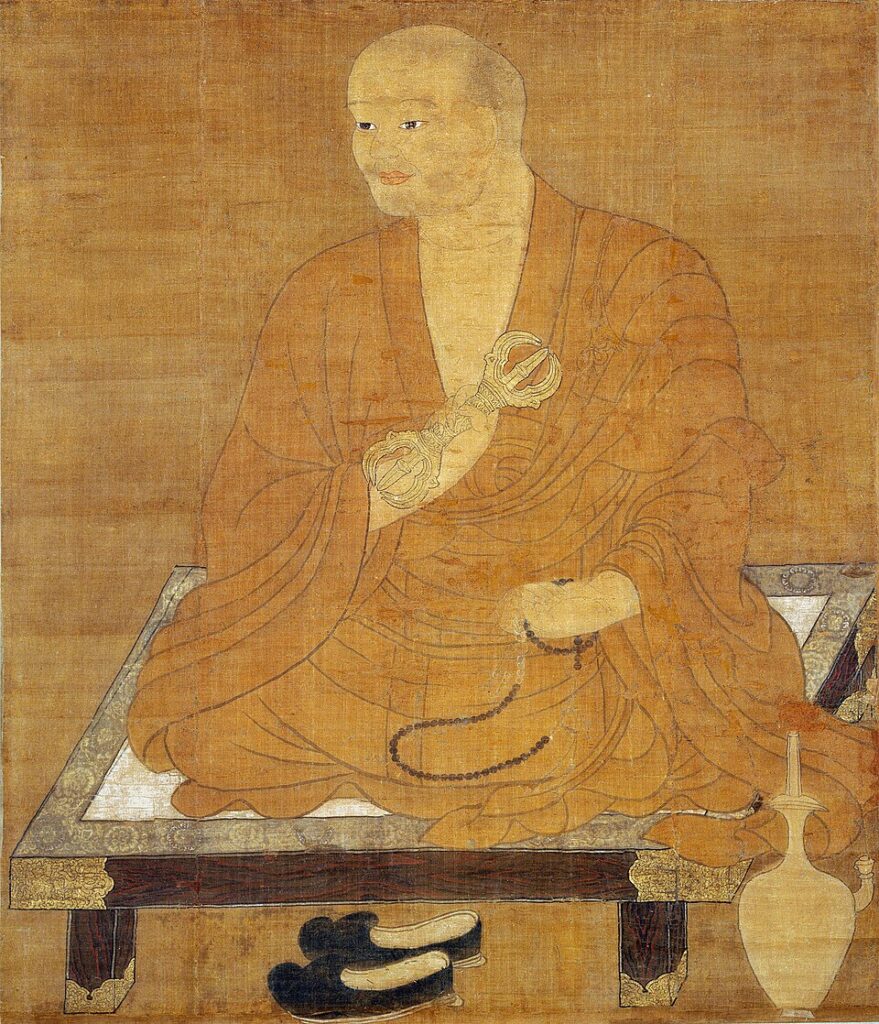
When visiting Koyasan, it quickly becomes clear that this is more than a historic temple complex. It is a place where the presence of one person is still deeply felt more than 1,200 years after his lifetime.
That person is Kūkai (774–835), better known by his posthumous name, Kōbō Daishi. He was a Buddhist monk, scholar, calligrapher, engineer, and one of the most influential figures in Japanese history. More importantly for many believers, he is not regarded as someone who “lived” on Koyasan—he is believed to still be there today.
The Early Life of Kūkai
Kūkai was born in present-day Kagawa Prefecture on the island of Shikoku in 774. Born into the Saeki clan, he received an excellent education and was expected to pursue a government career.
Instead, he chose a very different path.
Dissatisfied with worldly success, he devoted himself to Buddhist practice in the mountains. Seeking deeper knowledge, he traveled to Tang China in 804, where he studied Esoteric Buddhism under the great master Huiguo. Remarkably, he completed years of training in only a short time before returning to Japan with scriptures, ritual objects, and teachings that would later become the foundation of Shingon Buddhism.
The Legend of the Three-Pronged Vajra
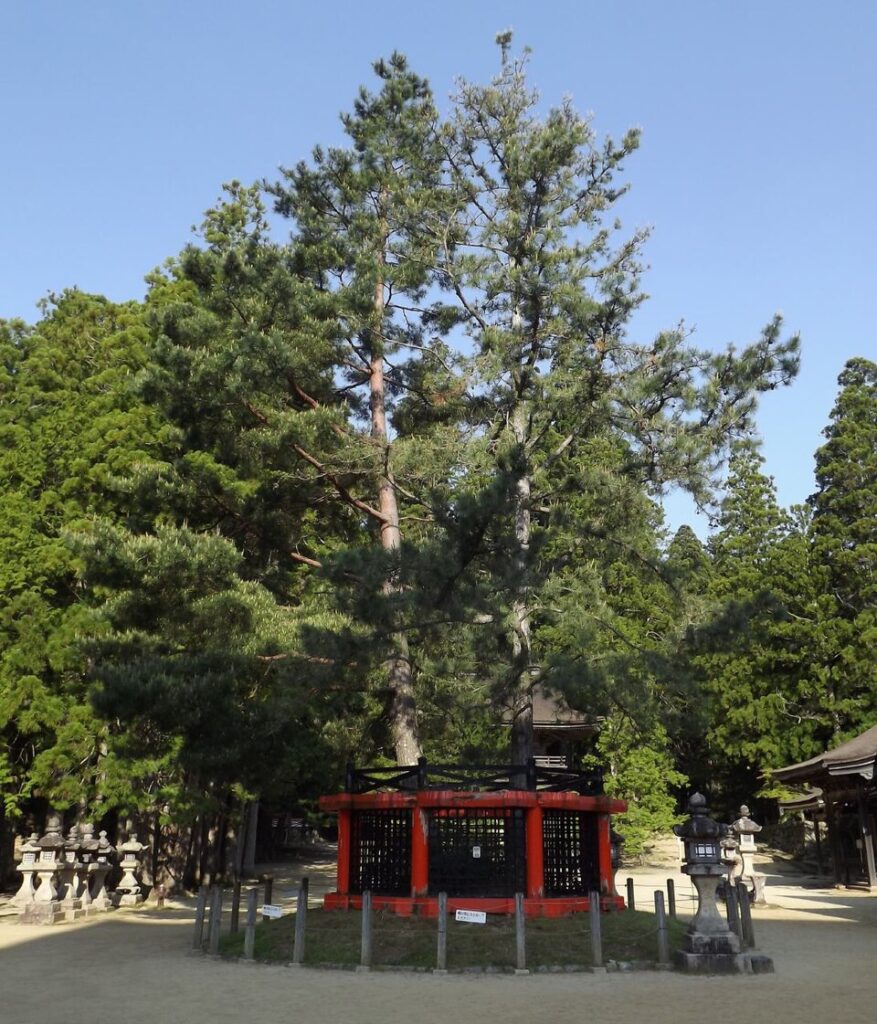
One of the most famous stories about Koyasan begins after Kūkai returned from China.
According to tradition, he threw his three-pronged vajra (sankosho) into the sky, praying that it would land in the ideal place to establish a center for Esoteric Buddhist practice. Years later, while searching through the mountains of the Kii Peninsula, he discovered that the vajra had become lodged in a pine tree on Koyasan.
This miraculous sign convinced him that he had found the sacred site he had been seeking.
Whether taken as history or legend, the story symbolizes the belief that Koyasan was not simply chosen by Kūkai—it was a place destined for him.
Guided by a White Dog and a Black Dog
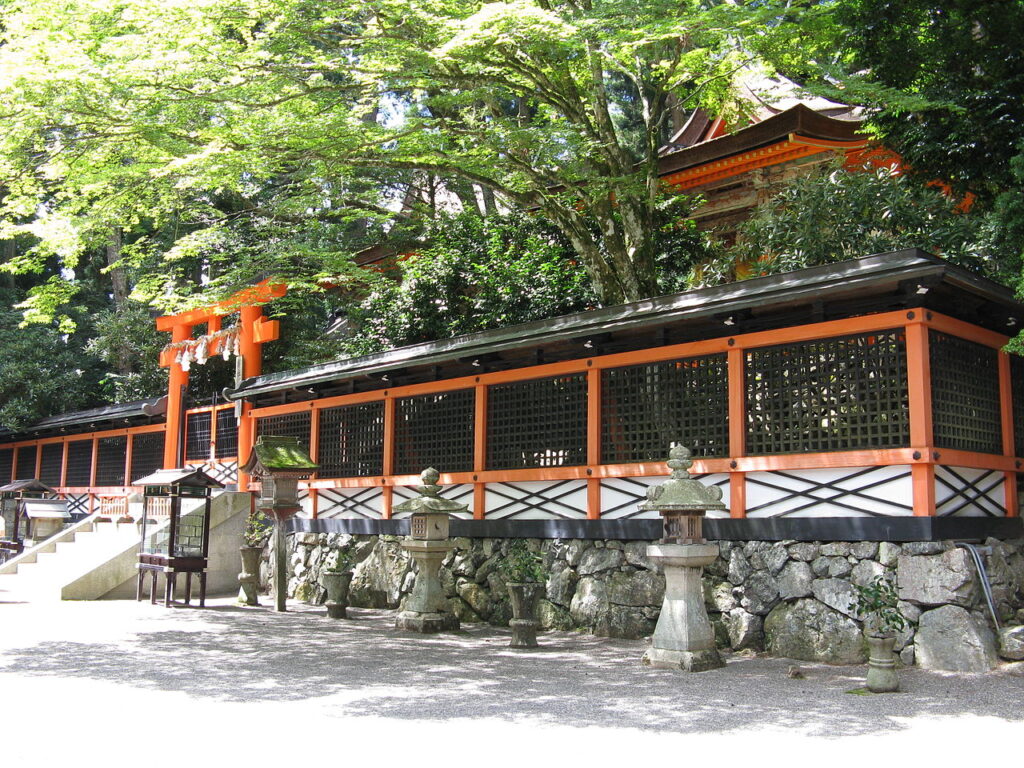
Another beloved legend tells how Kūkai became lost while searching for the mountain.
He encountered a mysterious hunter accompanied by one white dog and one black dog. After hearing Kūkai’s wish to establish a monastery, the hunter instructed the dogs to guide him through the mountains.
The dogs led Kūkai safely to the plateau of Koyasan.
The hunter later revealed himself to be Kariba Myojin, a local deity, while Niu Myojin, the guardian goddess of the region, granted Kūkai the land on which to build his monastery. The story beautifully illustrates the harmony between Buddhism and Japan’s indigenous beliefs that characterizes Koyasan to this day.
Creating a Sacred Mountain
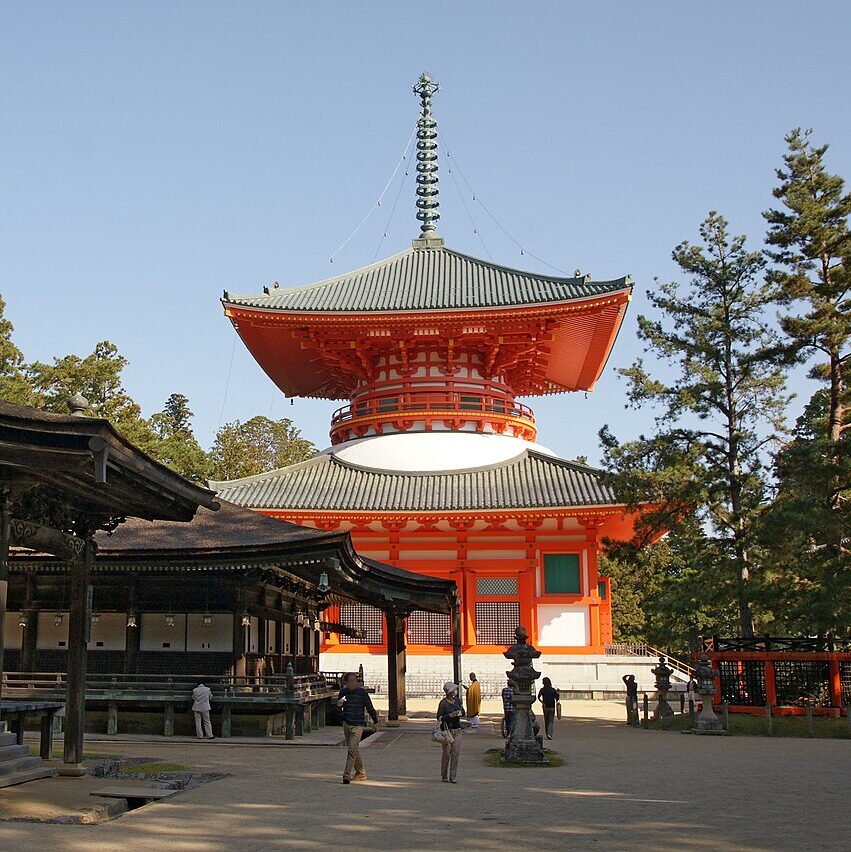
In 816, Emperor Saga granted Kūkai permission to establish a monastery on Mount Koya.
Rather than constructing a single temple, Kūkai envisioned an entire sacred landscape.
At its center lies the Danjo Garan, representing the spiritual heart of Koyasan, while the towering Konpon Daito Pagoda symbolizes the cosmic universe described in Esoteric Buddhism. Every temple, hall, and pathway was intended to express Buddhist teachings through architecture and landscape.
Today, Koyasan remains the headquarters of the Shingon school and continues to welcome pilgrims from around the world.
Kūkai Did Not Die—He Entered Eternal Meditation
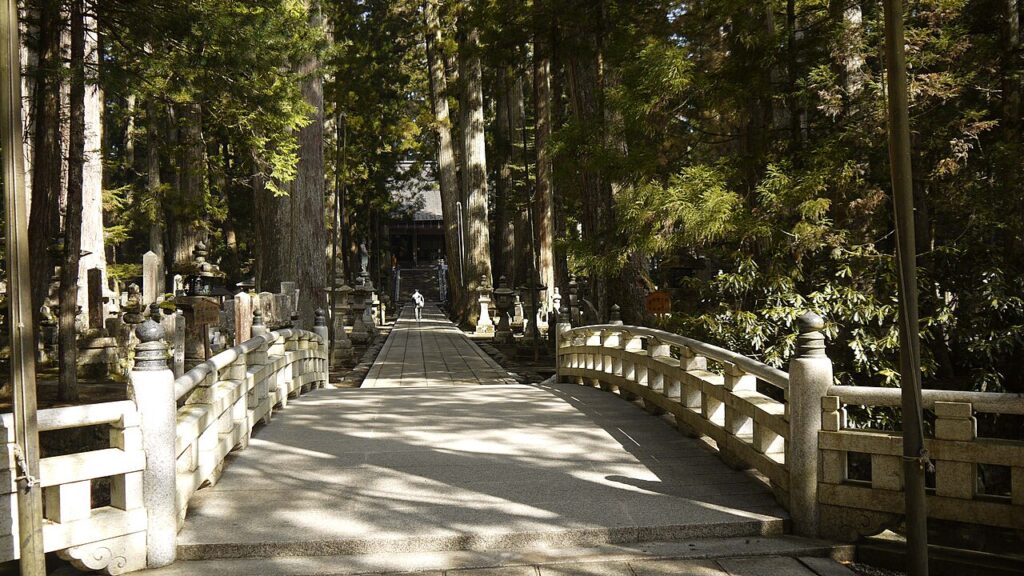
Perhaps the most distinctive belief associated with Kūkai concerns his death.
According to Shingon tradition, Kūkai did not die in the ordinary sense. Instead, in 835 he entered nyujo—eternal meditation—in Okunoin.
Followers believe that he continues to meditate there for the benefit of all living beings, awaiting the arrival of the future Buddha, Maitreya.
For this reason, meals are still offered every day at his mausoleum. Pilgrims visit Okunoin not as a memorial to someone who has passed away, but as a place where Kōbō Daishi is believed to remain spiritually present.
This living faith gives Okunoin an atmosphere unlike almost any other cemetery in Japan.
The Words at the Daimon Gate
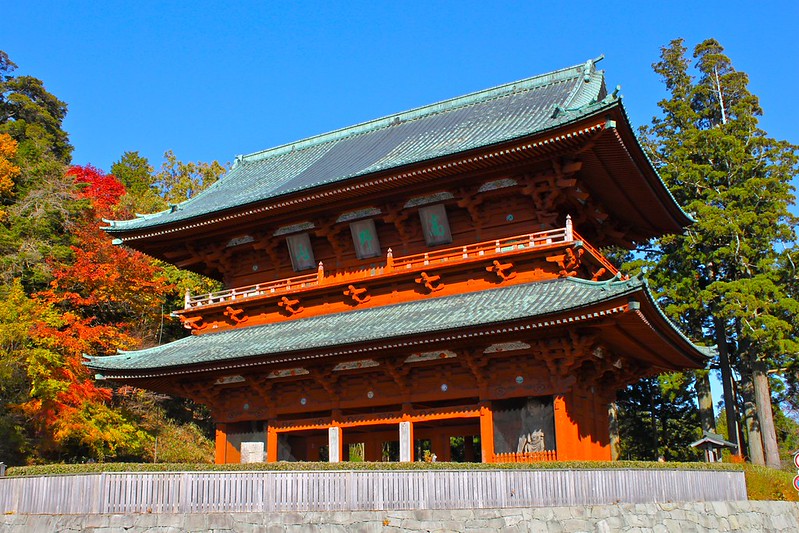
Many visitors pass through the great western gate of Koyasan—the Daimon—without noticing the inscriptions displayed there.
The inscription expresses a profound Shingon belief:
“Every morning, Kobo Daishi emerges from his meditation, makes his rounds, and offers salvation.”
Rather than remembering Kūkai only as the founder of Koyasan, these words remind visitors that he is believed to continue watching over the mountain and those who come seeking guidance. The inscription reflects the enduring belief that Kōbō Daishi remains in eternal meditation while compassionately caring for all people.
Why Kūkai Still Matters Today
More than twelve centuries after he founded Koyasan, Kūkai remains one of Japan’s most influential religious figures.
His legacy extends beyond Buddhism into calligraphy, education, engineering, philosophy, and Japanese culture itself.
Yet for many visitors, what leaves the deepest impression is not simply his historical achievements.
It is the feeling that Koyasan is still a living place of faith.
Whether walking beneath the ancient cedar trees of Okunoin, standing before the Konpon Daito, or entering through the great Daimon Gate, travelers encounter not only the memory of Kūkai but a tradition that believes his compassionate presence continues to guide those who make the journey today.
Learn More About Koyasan
- How Okunoin Reflects Japanese Views of Life and Death
- Sacred Art of Koyasan: Exploring Buddhist Architecture, Mandalas, and Hidden Treasures
- Women’s Koyasan: Understanding Nyonin Koya, the Nyonin-do, and the Nyonin-michi
No responses yet