
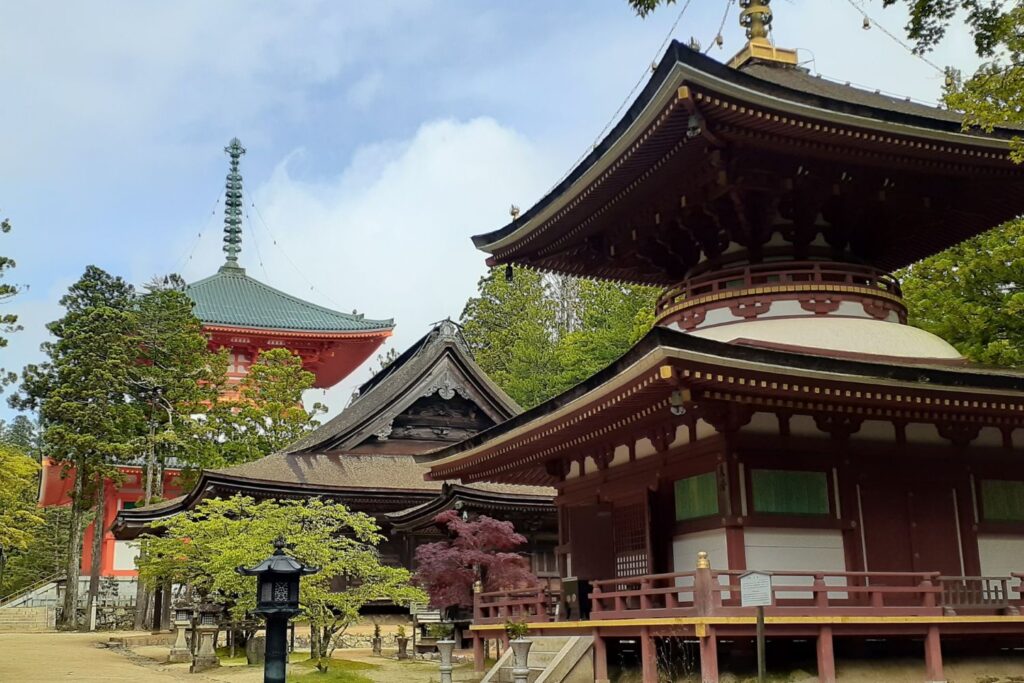
Discover the Artistic Universe Hidden Within Japan’s Sacred Mountain
When travelers visit Koyasan, they often focus on temple lodging, meditation, or the famous Okunoin Cemetery.
But beyond its spiritual reputation, Koyasan is also one of Japan’s greatest repositories of Buddhist art.
Here, architecture, sculpture, painting, color, and sacred symbolism come together to create an artistic world unlike anywhere else in Japan.
Rather than seeing Koyasan as a collection of separate buildings, it can be understood as a vast three-dimensional expression of Esoteric Buddhism—a place where art and spirituality become inseparable.
For travelers interested in Japanese aesthetics, history, architecture, or religious culture, Koyasan offers far more than a temple visit.
It offers an opportunity to step inside a living work of art.
Entering the Sacred Realm: Daimon Gate and the Guardian Kings
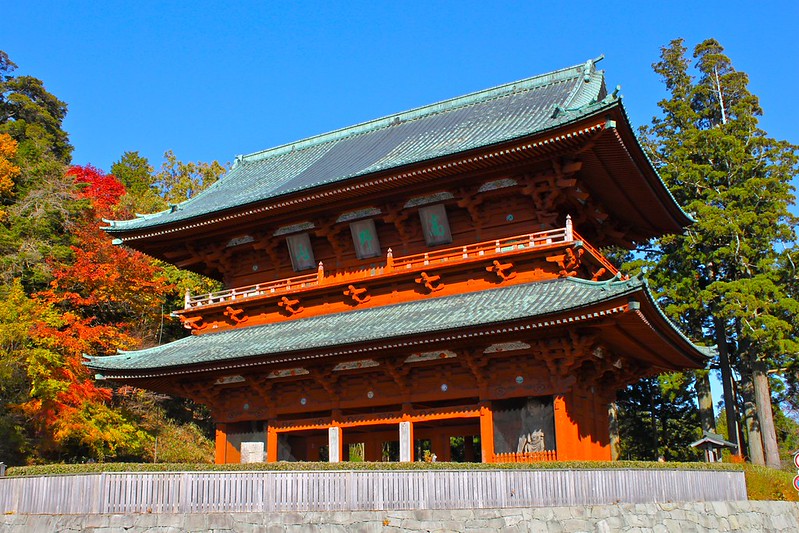
The journey begins at the imposing Daimon Gate, one of the symbolic entrances to Koyasan.
Standing on either side are two powerful Nio guardian statues. Their fierce expressions may appear intimidating, but their role is not to frighten visitors.
Instead, they protect the sacred world beyond the gate.
For centuries, pilgrims entering Koyasan passed beneath these statues, leaving the ordinary world behind and stepping into a different spiritual landscape.
Understanding the meaning of these guardians transforms the gate from a beautiful structure into a powerful piece of visual storytelling.
Learn More:
A Beginner’s Guide to Buddhist Statues in Japan
Danjo Garan: The Heart of Koyasan
At the center of Koyasan lies Danjo Garan, the sacred complex established by Kobo Daishi (Kukai).
Its arrangement is not random.
Every building reflects the cosmology of Esoteric Buddhism.
Walking through the complex becomes an experience of reading sacred space rather than simply sightseeing.
The Four Heavenly Kings of Chumon Gate
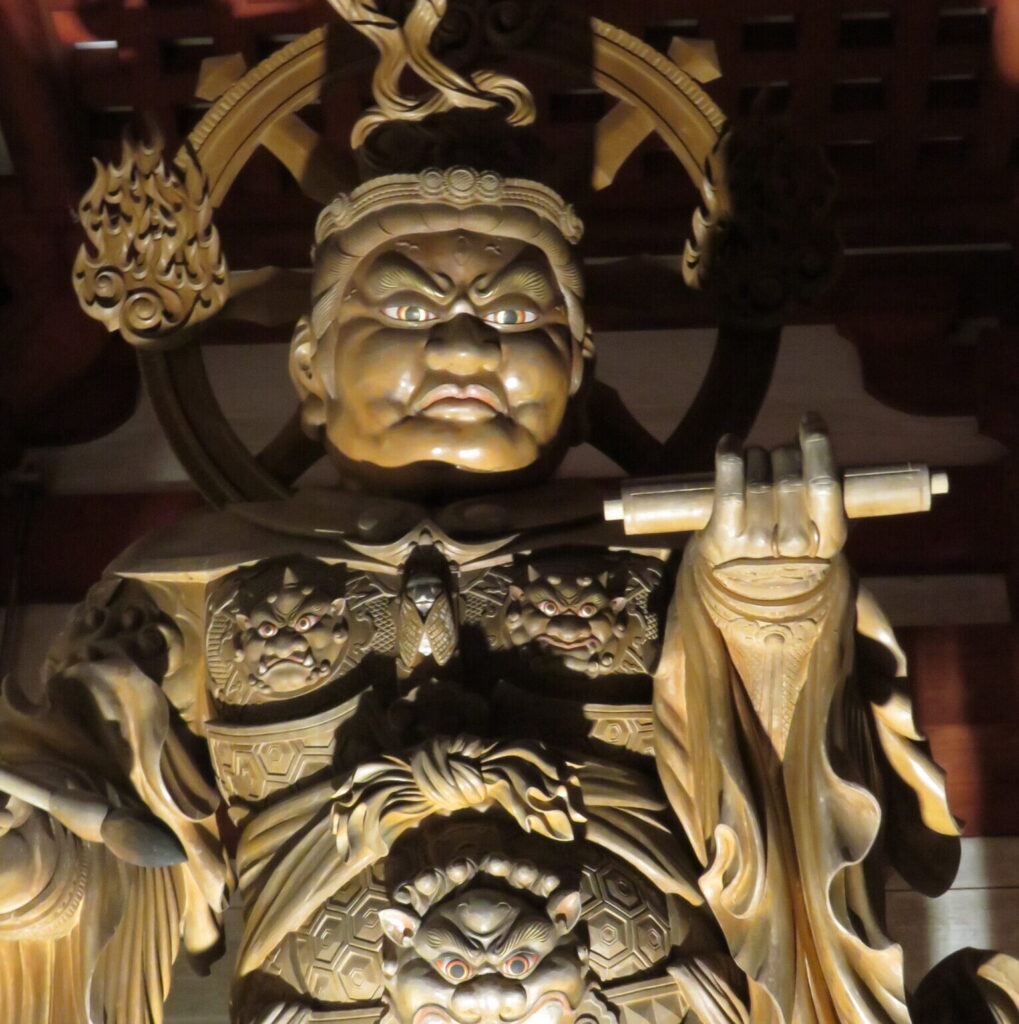
One of the highlights of Danjo Garan is the reconstructed Chumon Gate.
Inside stand the Four Heavenly Kings, each protecting one direction of the Buddhist universe.
Their armor, facial expressions, weapons, and poses differ from one another, revealing distinct personalities and responsibilities.
These statues demonstrate how Buddhist sculpture was designed not only for beauty but also for conveying complex religious ideas.
Konpon Daito: The Three-Dimensional Mandala
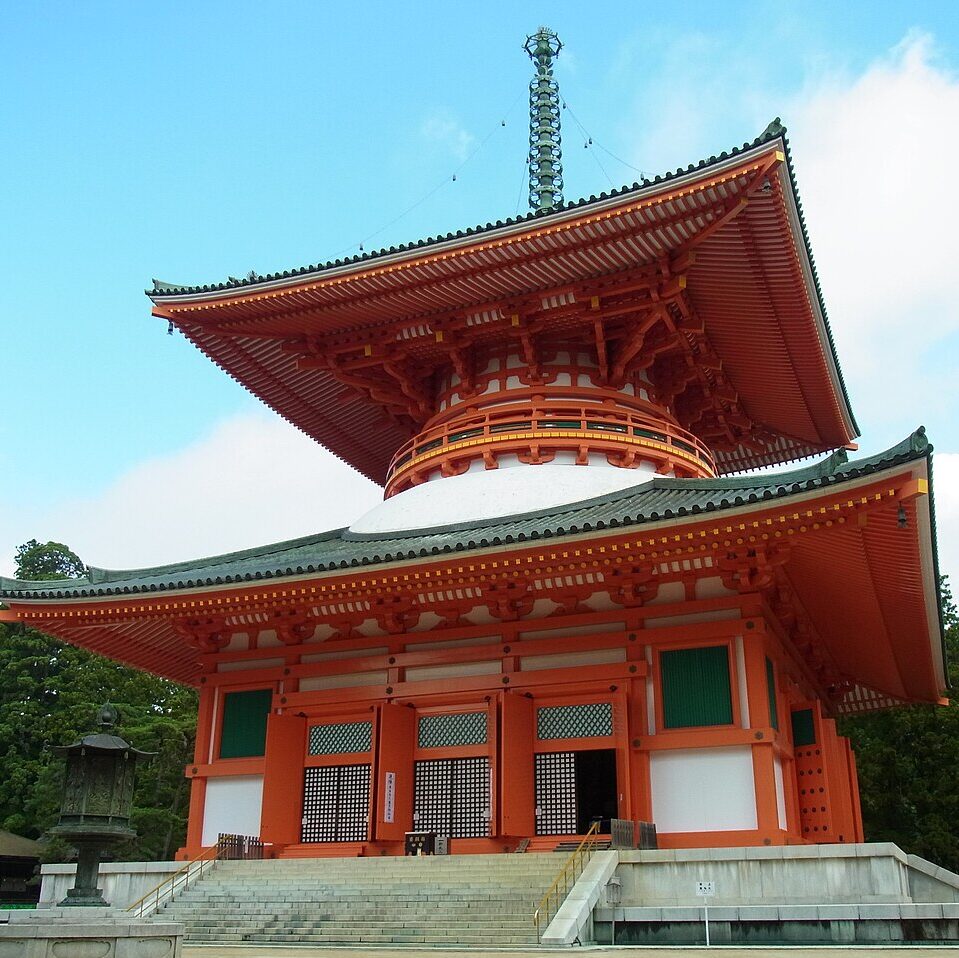
Perhaps the most extraordinary artistic space in Koyasan is the Konpon Daito.
Unlike traditional paintings displayed on walls, the interior presents a three-dimensional mandala.
At its center sits Dainichi Nyorai, surrounded by Buddhas and Bodhisattvas arranged according to Esoteric Buddhist teachings.
Colors, placement, and symbolism all work together to represent the universe itself.
For many visitors, this space reveals an important insight:
In Esoteric Buddhism, a mandala is not merely something to look at.
It is a world to enter.
Reihokan Museum: Hidden Treasures of Koyasan
While many visitors focus on the famous temples, the Reihokan Museum preserves thousands of artistic and religious treasures accumulated over more than twelve centuries.
The collection includes:
- Buddhist statues from different periods
- Sacred paintings and mandalas
- Ritual objects used in Esoteric Buddhism
- National Treasures and Important Cultural Properties
The museum allows visitors to appreciate the evolution of Buddhist art across Japanese history and offers a deeper understanding of the traditions that shaped Koyasan.
Understanding the Invisible Through Technology
Modern technology has created a new way to experience this ancient mountain.
The Koyasan Digital Museum uses immersive visual displays and digital reconstructions to help visitors understand spaces and symbols that are sometimes difficult to grasp through observation alone.
After seeing the actual temples and artworks, these digital experiences provide a fascinating second perspective and often reveal details that visitors may have overlooked.
More Than a Temple Visit
Koyasan is not only a place of worship.
It is also a place where architecture, sculpture, painting, and philosophy merge into a unified artistic vision.
For travelers who enjoy museums, Japanese aesthetics, photography, architecture, or cultural history, Koyasan offers an experience far deeper than a typical sightseeing itinerary.
Rather than asking, “Which temple should I visit?”
A more interesting question may be:
How can we learn to read the artistic language hidden within Koyasan?
That question turns a visit to Koyasan into something much richer—a journey through one of Japan’s greatest masterpieces.
Curated Experience
This private experience can be customized for travelers interested in:
- Buddhist art and iconography
- Japanese architecture
- Photography
- Cultural history
- Museum visits
- Esoteric Buddhism and Kukai
The pace and depth of explanation can be adjusted according to each guest’s interests, from first-time visitors to serious art enthusiasts.
Dive into the world of the Buddhism Art through Curated Kii Peninsula Journey.
Read More About Koyasan
- World Heritage Pilgrimage to Koyasan: From Human Prayer to Sacred Realization
- The Full Journey to Koyasan: From Sacred Peak to Valley Towns
- The Hidden Side of Koyasan: Beyond Okunoin
- Is Koyasan Worth a Guide? (And How to Experience It Properly)
- Kūkai: The Monk Who Founded Koyasan and Still Watches Over It
No responses yet