
A Slow Journey Through Gateway Towns, Sacred Temples, and the Rural Landscapes of Wakayama
When travelers visit Koyasan, the journey often begins and ends on the mountain itself.
Arrive by train and cable car. Visit the major temples. Stay in a temple lodging. Then continue to the next destination.
But there is another way to experience Koyasan.
Instead of treating the sacred mountain as an isolated destination, spend several days exploring the towns, roads, temples, and rural landscapes that surround it.
This five-day journey begins in Koyaguchi, continues through Kudoyama, ascends to Koyasan, and finally descends into the peaceful countryside of Amano.
It is a journey through the cultural landscape surrounding Koyasan—not simply a checklist of famous sights.
Why Spend Five Days Around Koyasan?
Koyasan is often described as a mountain temple complex, but its history extends far beyond the mountaintop.
For centuries, pilgrims, monks, merchants, craftsmen, and local residents moved between the mountain and the communities below.
Koyaguchi and Kudoyama were part of this wider world.
The surrounding countryside also provided food, materials, crafts, and connections to the religious center above.
By slowing down, travelers can begin to see Koyasan as part of a much larger landscape.
The journey also creates a natural progression:
Town → Pilgrimage Gateway → Sacred Mountain → Deeper Religious History → Rural Sacred Landscape
That makes this itinerary particularly suitable for travelers interested in slow travel, history, spirituality, architecture, and local life.
Day 1 — Koyaguchi
Discover the Town at the Foot of the Mountains
Begin your journey in Koyaguchi, a historic town at the foot of the mountains.
Rather than heading immediately toward Koyasan, spend your first day getting to know the landscape that surrounds the sacred mountain.
Koyaguchi has traditionally been associated with commerce, textiles, travel, and its role as one of the gateways toward Koyasan.
Its quieter streets offer a completely different atmosphere from Kyoto or Osaka.
Explore the Historic Streets
Take a relaxed walk through the town and look for traditional buildings, old commercial architecture, shrines, and traces of its former role as a transportation hub.
This is not a destination where you need to rush from one attraction to another.
The point is to notice the relationship between the town and the mountains beyond it.
The journey to Koyasan has already begun.
Stop at Katsuragikan
One of the most distinctive places to visit is Katsuragikan, a historic inn whose architecture recalls the era when travelers passed through the region.
A coffee or tea break here provides a chance to slow down and appreciate the atmosphere of the old town.
Rather than simply photographing an old building, consider it as part of the story of people who once traveled between the lowlands and the sacred mountain.
Relax in a Local Hot Spring
In the late afternoon, enjoy a local hot spring before dinner.
The combination of walking, bathing, and a quiet evening creates an ideal beginning to a five-day journey.
There is no need to make the first day intensive.
The purpose is to gradually leave the pace of urban Japan behind.
Overnight: Koyaguchi Area
Day 2 — Kudoyama
A Town of Samurai, Pilgrims, and Sacred Gateways
On the second day, continue to Kudoyama.
The town is famous for its association with the samurai Sanada Yukimura, but its significance goes beyond samurai history.
Kudoyama is also closely connected to the pilgrimage landscape leading toward Koyasan.
Walk Through Kudoyama
The compact streets make the town easy to explore slowly.
Look beyond individual attractions and notice the relationship between:
- Historic houses
- Small temples and shrines
- Local shops
- Traditional crafts
- Agricultural landscapes
This is one of the places where the everyday world of Wakayama meets the history of Koyasan.
Visit Jison-in
Continue to Jison-in, one of the most important places for understanding the connection between Kudoyama and Koyasan.
The temple can be understood as part of the spiritual gateway to the mountain.
Standing here before visiting Koyasan itself helps put the following days into context.
Instead of seeing Koyasan as a destination that suddenly appears at the end of a train journey, you begin to understand the network of places connected to it.
Visit Niutsuhime-Related Sacred Sites
Continue to the nearby Niutsuhime-related sacred landscape, including Niukanshofu Shrine.
The combination of temple, shrine, road, and surrounding countryside reveals how religious traditions were embedded in the wider landscape rather than confined to one temple complex.
Local Food and Rural Landscapes
Take time for lunch featuring local food.
Kudoyama and the surrounding area are particularly associated with agriculture and fruit cultivation, including persimmons.
Local food is therefore more than something to eat along the way—it is part of the landscape itself.
Optional Craft Experiences
For travelers interested in traditional culture, Kudoyama can also be a place to explore crafts such as Sanada Himo or traditional papermaking.
These experiences provide another connection between the communities below the mountain and the religious culture preserved at Koyasan.
Overnight: Kudoyama Area
Day 3 — Koyasan
Enter the Sacred Mountain
On the third morning, finally ascend to Koyasan.
After two days in the foothills, arriving on the mountain feels different.
You are no longer simply visiting a famous temple destination.
You are entering the center of the landscape you have been following.
Daimon
Begin at Daimon, the traditional western entrance to Koyasan.
The massive gate creates a powerful transition from the surrounding mountain landscape into the sacred settlement.
Pause here before continuing.
The journey has changed from traveling toward Koyasan to moving through Koyasan.
Danjo Garan
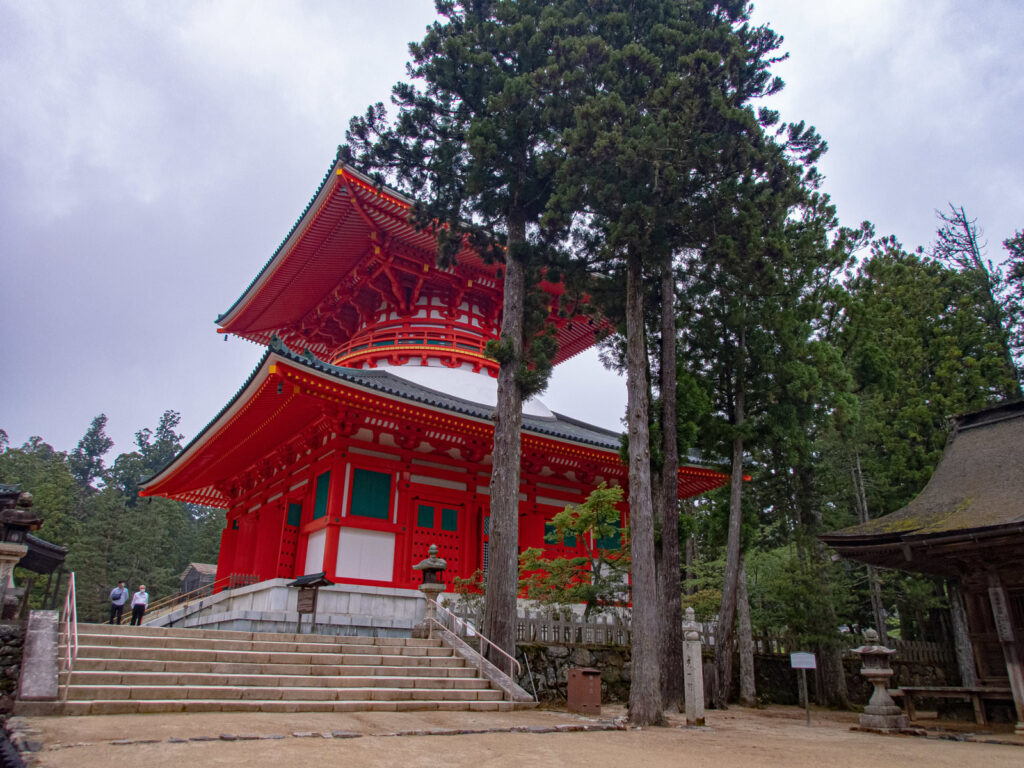
Continue to Danjo Garan, one of the central sacred areas of Koyasan.
Explore the temple buildings and pagoda while considering the larger religious structure of the mountain.
This is an ideal place to spend time rather than simply taking photographs and moving on.
Kongobu-ji
After lunch, visit Kongobu-ji, the head temple of Koyasan’s Shingon Buddhist tradition.
Its architecture, gardens, artwork, and spaces for religious practice provide another layer to understanding the mountain.
Okunoin
In the late afternoon, walk toward Okunoin.
The approach through the cedar forest is one of the most atmospheric experiences in Koyasan.
Stone monuments, moss, ancient trees, and lanterns create a landscape where nature and religious history are inseparable.
If possible, allow enough time to experience the approach slowly.
Evening at a Temple Lodging
A stay in a shukubo, or temple lodging, adds another dimension to the experience.
Rather than simply sleeping near the attractions, you have the opportunity to experience the rhythm of temple life.
For travelers interested in spirituality, food, architecture, or Japanese cultural traditions, this can be one of the highlights of the entire journey.
Overnight: Koyasan
Day 4 — Koyasan
Look Beyond the Famous Temples
The fourth day stays on Koyasan, but the emphasis changes.
Day 3 introduced the major sacred spaces.
Day 4 is about discovering the less obvious layers of the mountain.
Nyonin-do
Begin at Nyonin-do, one of the historic women’s halls.
The site opens a different perspective on Koyasan and its historical restrictions surrounding access to the sacred mountain.
It is a reminder that religious landscapes are also shaped by social history.
Tokugawa Mausoleum
Continue to the Tokugawa Mausoleum.
Here the story of Koyasan intersects with the political history of early modern Japan.
The mountain was not isolated from the powerful families and political structures that shaped Japanese history.
Kongosanmaiin
Next, visit Kongosanmaiin.
Its history and architecture provide another opportunity to move beyond the most familiar Koyasan itinerary.
Rather than seeing every temple as simply another temple, look at how different institutions developed within the mountain’s religious community.
Reihokan Museum
Finish the cultural portion of the day at the Reihokan Museum.
After seeing temples and religious spaces in their original environment, the museum provides an opportunity to examine Koyasan’s cultural heritage through its preserved artworks and treasures.
This makes the fourth day particularly valuable for travelers interested in:
- Buddhist art
- Japanese architecture
- Religious history
- Cultural heritage
- Photography
- The history of Koyasan
A Slow Evening
Keep the evening intentionally open.
Return to your lodging, enjoy another temple meal, walk quietly through the town, or revisit a place that particularly interested you.
After three days of movement, having an unhurried evening is part of the experience.
Overnight: Koyasan
Day 5 — Amano
From the Sacred Mountain to the Rural Landscape
For the final day, leave Koyasan and descend toward Amano.
This is an especially fitting ending because the journey finishes not at another major tourist attraction, but in a quieter rural landscape.
Niutsuhime Shrine
The main destination is Niutsuhime Shrine, set within the peaceful landscape of Amano.
After spending several days exploring Koyasan’s temples, the atmosphere here feels distinctly different.
There is more open countryside.
Rice fields and mountains surround the sacred space.
The experience helps reveal that the religious world of Koyasan has always existed in relationship with the surrounding countryside.
Walk Through Amano
Do not rush directly to the shrine and leave.
Spend time walking through the surrounding rural landscape.
This is where the journey can shift from:
temples and institutions
to:
fields, villages, agriculture, and everyday life.
That transition is important.
The mountain may be sacred, but the surrounding communities and landscapes are part of the story too.
What Makes This Five-Day Journey Different?
The conventional Koyasan itinerary might look something like:
Osaka → Koyasan → temples → Osaka
This journey takes a different approach:
Koyaguchi → Kudoyama → Koyasan → Amano
The difference is not simply the number of destinations.
It is the way the destinations are connected.
Day 1
The Town
Discover the communities below the mountain.
Day 2
The Gateway
Understand the religious and historical routes toward Koyasan.
Day 3
The Sacred Center
Explore the major temples and sacred spaces.
Day 4
The Deeper Layers
Look at religion, politics, art, and social history.
Day 5
The Countryside
Return to the rural landscape surrounding the sacred world.
A Journey for Slow Travelers
This itinerary is particularly suitable for travelers who don’t want to rush through Japan’s major destinations.
Instead of asking:
How many places can I see in five days?
the better question is:
How deeply can I understand one place and the landscape around it?
The answer is surprisingly deep.
Koyasan becomes more meaningful when you understand the towns below it.
Kudoyama becomes more meaningful when you understand its relationship with the mountain.
And Amano becomes more meaningful after you have spent several days immersed in Koyasan’s religious world.
This is what makes the journey more than a Koyasan sightseeing itinerary.
It becomes a journey through the cultural landscape of the sacred mountain.
When to Take This Journey
Spring and autumn are particularly comfortable for exploring the towns, temples, and surrounding landscapes.
Summer can be beautiful but warmer in the lower elevations, while Koyasan itself offers a cooler mountain environment.
Winter brings a completely different atmosphere to Koyasan, especially when snow and mist transform the cedar forests and temple grounds.
For photographers and travelers interested in atmosphere, weather can actually become part of the experience. Koyasan’s forests and sacred spaces change dramatically with fog, snow, seasonal foliage, and changing light.
Extend Your Journey
Five days is enough to create a meaningful introduction, but the same concept can easily be expanded.
You could add:
- Choishi-michi hiking toward Koyasan
- More time in Kudoyama
- Traditional craft experiences
- Local food experiences
- Temple lodging and morning prayers
- Photography walks
- Additional rural walks around Amano
Koyasan also works particularly well as part of a wider Kii Peninsula journey, connecting the sacred mountain with Kumano Kodo, Wakayama’s coastal communities, food culture, and other historic landscapes.
Wakayama’s hiking experiences are especially suited to this kind of travel because walking can connect nature with history, food, villages, and everyday life rather than functioning as an isolated outdoor activity.
Final Thoughts
Koyasan is one of Japan’s great sacred destinations.
But perhaps the best way to understand it is not to arrive directly at the top of the mountain.
Start below.
Walk through the old towns.
Follow the historical connections.
Enter the sacred mountain slowly.
Spend time with its temples, forests, art, and history.
And finally descend again into the rural landscape.
Koyasan is not only a destination. It is a landscape of connections.
And sometimes, the journey to a sacred place is just as important as the place itself.
Experience Koyasan Beyond the Standard Itinerary
For travelers who want to explore Koyasan at a slower pace, a private journey can combine the sacred mountain with Koyaguchi, Kudoyama, Amano, local food, crafts, walking routes, and cultural interpretation.
Rather than simply visiting the famous temples, the journey can be shaped around your interests—whether they are spirituality, history, architecture, photography, food, hiking, or Japanese rural life.
Explore Koyasan as part of a deeper journey through Wakayama and the Kii Peninsula.
My tour Curated Kii Peninsula Journey can help your travel around Koyasan. Please check it!
Read More About Koyasan
- Walking the Sacred Roads of Wakayama: A 10-Day Pilgrimage Journey
- Walking Choishi-michi: Following the Pilgrims to Koyasan
- Kūkai: The Monk Who Founded Koyasan and Still Watches Over It
- Women’s Koyasan: Understanding Nyonin Koya, the Nyonin-do, and the Nyonin-michi
- What Makes Okunoin Different from Ordinary Cemeteries?
- Sacred Art of Koyasan: Exploring Buddhist Architecture, Mandalas, and Hidden Treasures
No responses yet