
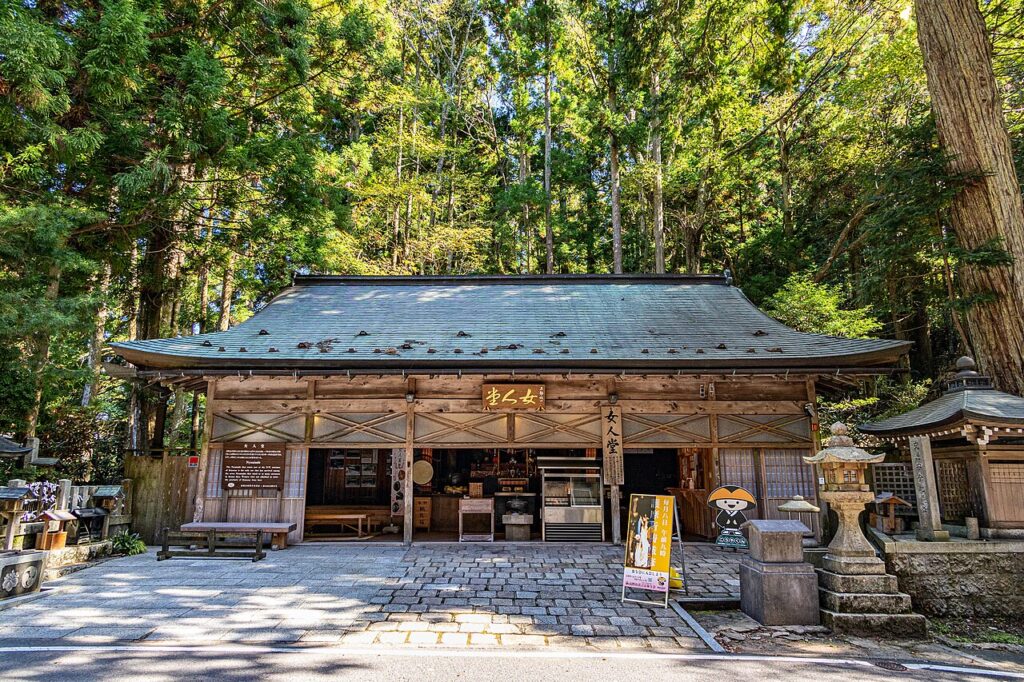
A Journey Through Faith, Pilgrimage, and the History of Women on Mount Koya
Koyasan is one of Japan’s most important centers of esoteric Buddhism. Founded by Kukai in the early ninth century, it has attracted pilgrims for over 1,200 years.
Yet for much of its history, one group of believers could not enter the sacred mountain.
Until the late nineteenth century, women were prohibited from entering Koyasan because of the tradition of nyonin kekkai (women’s exclusion). Although they could not worship within the monastery itself, countless women still traveled to the foot of the mountain in search of spiritual merit.
This history gave rise to three remarkable places that together tell the story of women’s pilgrimage:
- Jison-in (Women’s Koyasan)
- Choishi-michi (the Pilgrimage Trail)
- Nyonin-michi and the Nyonin-do (Women’s Pilgrimage Path and Women’s Halls)
Together, they preserve a unique chapter in Japanese religious history.
What Is “Women’s Koyasan”?
The name Women’s Koyasan (Nyonin Koya) refers to Jison-in, located at the foot of Koyasan.
According to tradition, Kukai’s mother was welcomed here because women were not permitted to enter the sacred mountain. Kukai is said to have descended from Koyasan regularly to visit her, a story closely associated with the origin of the place name Kudoyama (“Nine Visits Mountain”). Over time, Jison-in became the destination where female pilgrims could worship in place of entering Koyasan itself.
Because of this history, Jison-in became known as Women’s Koyasan, and even today it is widely visited by people praying for safe childbirth, child-rearing, good health, and family happiness.
The temple is also part of the UNESCO World Heritage property Sacred Sites and Pilgrimage Routes in the Kii Mountain Range.
Walking the Choishi-michi: The Original Pilgrimage Route
From Jison-in begins one of Japan’s finest pilgrimage trails—the Choishi-michi (Township Marker Trail).
Stretching approximately 24 kilometers, this historic route climbs from the foothills to Koyasan through forests, mountain villages, and cedar groves. Along the way stand 180 stone markers, placed roughly every cho (about 109 meters), guiding pilgrims toward the sacred mountain. Most of these stone markers date from the Kamakura period, replacing earlier wooden markers that had deteriorated over time.
Unlike many hiking trails, every step along the Choishi-michi carries symbolic meaning. The markers are said to represent the Buddhist mandalas of the Womb Realm and Diamond Realm, transforming the walk itself into an act of devotion.
For many women throughout history, however, this road ended before they could fully enter the sacred mountain.
The Nyonin-do: Waiting at the Sacred Boundary
For centuries, women climbed the mountain only as far as the Nyonin-do (Women’s Halls).
These halls stood at the entrances to Koyasan, marking the boundary of the former women’s exclusion zone. Female pilgrims stayed, prayed, and rested here while looking toward the area they were forbidden to enter.
Historically there were seven Nyonin-do surrounding Koyasan, corresponding to the major approaches to the mountain. Today, only the Fudozaka-guchi Nyonin-do survives, serving as a powerful reminder of this period in Japanese religious history.
Rather than symbols of exclusion alone, these halls also reflect the determination and deep faith of generations of women who journeyed great distances despite the restrictions of their time.
The Nyonin-michi: Walking Around the Sacred Mountain
Unable to enter the monastery, women developed another form of pilgrimage.
The Nyonin-michi (Women’s Pilgrimage Path) circles the outer edge of Koyasan, connecting the former Nyonin-do. Instead of passing through the sacred precinct, pilgrims walked around it, praying while viewing the temples from outside.
Today this trail offers one of the most rewarding hikes in Koyasan.
It combines:
- Quiet cedar forests
- Panoramic mountain views
- Historic pilgrimage sites
- A deeper understanding of Japan’s religious history
Unlike the busier temple district, the Nyonin-michi provides a peaceful experience where visitors can appreciate both nature and history.
From Exclusion to Inclusion
The prohibition on women entering Koyasan ended in 1872, during the early Meiji period, when the Japanese government abolished many traditional restrictions on access to sacred mountains.
Today, everyone is welcome to visit Koyasan regardless of gender.
Yet the stories preserved at Jison-in, along the Choishi-michi, and on the Nyonin-michi remain essential to understanding the mountain’s history. They remind us that pilgrimage has never been only about reaching a destination—it is also about perseverance, devotion, and the people who walked the road.
Why Visit These Places Today?
Many visitors focus only on Koyasan’s famous temples, but exploring Women’s Koyasan reveals another perspective.
A journey beginning at Jison-in, continuing along the Choishi-michi, and ending with a walk on the Nyonin-michi allows travelers to experience:
- The original approach used by medieval pilgrims
- The lives and faith of women before the Meiji era
- UNESCO World Heritage pilgrimage routes
- Beautiful forest landscapes with relatively few crowds
- A deeper understanding of Japanese Buddhism beyond temple architecture
Rather than simply visiting Koyasan, this route allows you to understand how pilgrimage shaped the lives of ordinary people—and how faith found a way even in the face of barriers.
Walk and Learn around Nyonin Koya with my Curated Kii Peninsula Journey.
Related Posts
- Why Were Pilgrims Willing to Walk on Kumano Kodo for Weeks?
- Koyasan & Kumano: The Sacred Network of the Kii Mountains
- World Heritage Pilgrimage to Koyasan: From Human Prayer to Sacred Realization
- Kūkai: The Monk Who Founded Koyasan and Still Watches Over It
No responses yet