
Discover Coral Reefs, Marine Life, and the Ramsar Wetland at the Southern Tip of Wakayama
When people imagine nature in Japan, they often picture cedar forests, mountain trails, or cherry blossoms.
Yet at the southern tip of Wakayama lies a completely different world—one where warm ocean currents, colorful coral reefs, and tropical fish create one of Japan’s richest marine ecosystems.
Kushimoto is home to the northernmost extensive coral communities in the world sustained by the warm Kuroshio Current. This remarkable environment has earned international recognition as a Ramsar Wetland of International Importance, making it one of the country’s most fascinating destinations for nature lovers.
Whether you enjoy snorkeling, diving, wildlife observation, or simply learning about nature, Kushimoto offers an experience unlike almost anywhere else in Japan.
The Power of the Kuroshio Current
The secret behind Kushimoto’s extraordinary biodiversity is the Kuroshio Current.
Flowing northward from the tropical Pacific Ocean, this powerful warm current carries heat, nutrients, and countless marine organisms toward Japan.
As the Kuroshio reaches the coast of southern Wakayama, it creates conditions rarely found elsewhere on the Japanese mainland.
This is why visitors can encounter coral reefs and tropical fish hundreds of kilometers farther north than they might expect.
The sea here represents a meeting point between temperate and subtropical ecosystems, producing an exceptional diversity of marine life.
A Ramsar Wetland Beneath the Waves
Many people associate the Ramsar Convention with marshes, lakes, and migratory birds.
Kushimoto challenges that assumption.
The coral communities around Kushimoto are internationally recognized under the Ramsar Convention on Wetlands, demonstrating that healthy marine ecosystems are just as valuable as inland wetlands.
These coral reefs are important because they provide habitat for countless marine species, protect coastal environments, and support one of Japan’s richest underwater ecosystems.
For travelers interested in conservation as well as beautiful scenery, Kushimoto offers an opportunity to see why these environments deserve international protection.
Coral Reefs at the Edge of Japan
One of Kushimoto’s greatest surprises is the variety of coral that can be found beneath the surface.
Visitors may encounter:
- Table corals spreading like underwater forests
- Branching corals that shelter small fish
- Soft corals swaying with the ocean currents
- Massive hard corals that have grown over many decades
Many visitors are surprised to learn that corals are animals, not plants.
Tiny coral polyps build limestone skeletons over many years, creating complex habitats that support thousands of other marine organisms.
These reefs are living ecosystems that continue to grow, change, and respond to the surrounding environment.
Marine Life You May Encounter
The waters around Kushimoto are famous among divers throughout Japan because of their incredible biodiversity.
Depending on the season and weather conditions, visitors may observe:
- Colorful clownfish living among sea anemones
- Butterflyfish and angelfish
- Moorish idols swimming over coral reefs
- Sea turtles gracefully passing through the bays
- Moray eels hiding among rocky crevices
- Seahorses camouflaged in sea grasses
- Nudibranchs displaying astonishing colors and patterns
- Lobsters, octopus, and numerous crustaceans
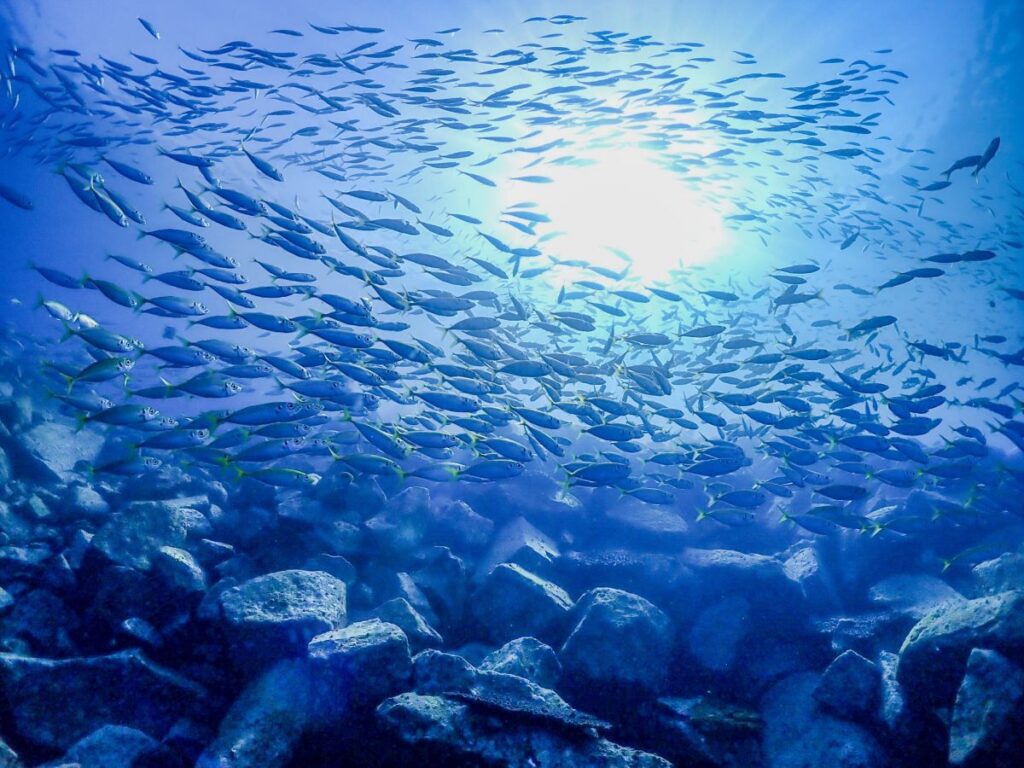
- Schools of migratory fish carried by the Kuroshio Current
Even experienced divers often return throughout the year because the marine life changes with the seasons.
Every dive offers something different.
Snorkeling for Beginners
You do not need to be an experienced diver to appreciate Kushimoto’s underwater world.
During the warmer months, many calm coastal areas are suitable for snorkeling, allowing visitors to observe coral reefs and tropical fish close to the surface.
For families and first-time visitors, snorkeling provides an accessible introduction to Japan’s southern marine environment without requiring advanced diving certification.
Explore the Ocean Without Getting Wet
Not everyone wishes to dive beneath the waves.
Fortunately, Kushimoto offers another way to experience its underwater world.
The Kushimoto Marine Park features an underwater observation tower where visitors can safely look into the surrounding sea through large viewing windows.
This allows children, older travelers, and people who do not swim to enjoy marine life in its natural habitat.
Aquariums and educational exhibits also help explain the ecology of the Kuroshio Current and the remarkable biodiversity of southern Wakayama.
Discover Life in the Tide Pools
Nature observation is not limited to deep water.
At low tide, rocky shores reveal countless tide pools filled with fascinating marine creatures.
These miniature ecosystems may contain:
- Hermit crabs
- Small fish
- Sea stars
- Sea cucumbers
- Tiny shrimp
- Various shellfish
Exploring tide pools encourages visitors to slow down and notice the incredible diversity hidden within just a few square meters of coastline.
For families with children, this can become one of the most memorable parts of a visit.
More Than Marine Life
The coastline itself tells another story.
Kushimoto’s dramatic rocky shores have been shaped over millions of years by waves, volcanic activity, and geological change.
Nearby, the famous Hashigui-iwa Rocks rise dramatically from the sea, creating one of Japan’s most distinctive coastal landscapes.
These unusual rock formations provide excellent opportunities for photography while also illustrating the geological forces that have shaped the Kii Peninsula.
Nature here exists both above and below the water’s surface.
Birds Along the Coast
The marine environment also supports a variety of coastal birds.
Depending on the season, visitors may observe:
- Black-tailed gulls
- Cormorants
- Ospreys hunting fish
- Various migratory seabirds
Bringing binoculars can add another dimension to a day spent exploring the coastline.
Protecting a Fragile Ecosystem
The beauty of Kushimoto’s sea also comes with responsibility.
Coral reefs are living organisms that can be damaged by careless contact, pollution, or environmental change.
Visitors can help protect this remarkable ecosystem by:
- Avoiding contact with coral
- Never collecting marine animals or shells
- Taking all litter home
- Choosing environmentally responsible sunscreen whenever possible
- Respecting wildlife and observing from an appropriate distance
Small actions by each visitor help ensure that future generations can experience the same extraordinary underwater world.
Experience a Different Side of Nature in Wakayama
Many visitors come to Wakayama for the sacred forests of the Kumano Kodo or the mountains of Koyasan.
Kushimoto reveals another side of the region.
Here, nature is shaped not by ancient cedar trees or mountain trails, but by warm ocean currents, living coral reefs, and an astonishing diversity of marine life.
Together, these landscapes show why Wakayama is one of Japan’s most ecologically diverse prefectures.
Whether you are snorkeling above colorful coral, watching fish from an underwater observation tower, exploring tide pools with your family, or photographing the dramatic coastline, Kushimoto offers a deeper appreciation of Japan’s natural world—one that begins beneath the waves.
Marine nature walks, coastal ecology tours, and customized nature experiences can be arranged as part of a private guided journey in Wakayama: Curated Kii Peninsula Journey
Read More About Nature in Wakayama
- Why Nature in Wakayama Is Different
- Understanding Japan’s Satoyama
- Discovering Tomogashima Through Nature
- Nature & Ancient History at Kii Fudoki-no-Oka
No responses yet