
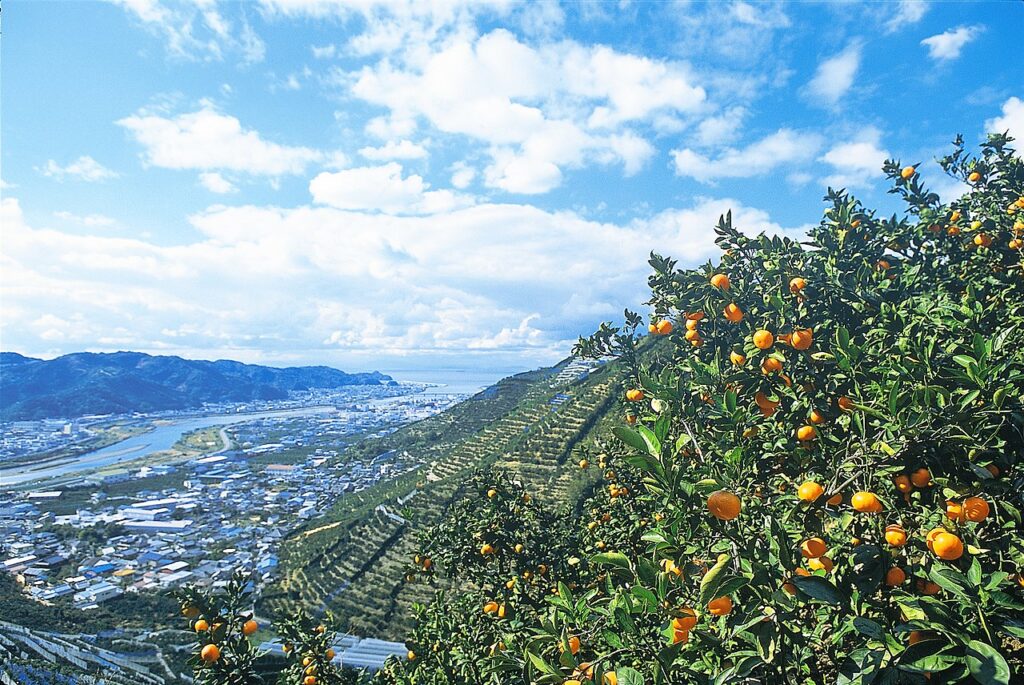
Discovering Arida’s Mikan Landscapes Near Kiimiyahara Station
As travelers walk south along the historic Kii Route from Kainan toward Yuasa, the landscape gradually begins to change.
Fishing villages and coastal scenery slowly give way to hills covered with citrus trees.
Around Kiimiyahara Station in Arida, one of Wakayama’s most iconic cultural landscapes unfolds before visitors:
The mikan terraces that have shaped life in this region for centuries.
Today, these hills are known throughout Japan for producing Arida Mikan, one of the country’s most beloved citrus varieties. But the story behind these orchards stretches much further back in time.
A History That Began More Than 500 Years Ago
Mikan cultivation in the Arida region is said to have begun during the fifteenth century.
During the Edo period, the first lord of the Kishu Domain, Tokugawa Yorinobu, encouraged citrus cultivation as an important industry for the region.
By the middle of the seventeenth century, Arida’s mikan were being shipped by sea to Edo, present-day Tokyo.
Their reputation spread steadily, and generations of farmers continued refining cultivation techniques that are still passed down today.
What visitors see now is not simply agriculture.
It is the result of centuries of accumulated knowledge and adaptation to the landscape.
Stone Terraces Recognized as a World Heritage Site
One of the most remarkable features of Arida’s citrus landscape is the extensive network of stone terraces built into the hillsides.
Because flat land is limited along this coastal region, farmers transformed steep slopes into productive orchards using carefully constructed stone walls.
These terraced fields, known as ishizumi kaidanen (stone-built stepped orchards), have become one of the defining landscapes of Wakayama and are recognized as part of Japan Heritage.
Walking through these hills, visitors quickly realize that the scenery itself represents generations of labor and ingenuity.
The landscape tells the story of how people learned to live with the mountains rather than against them.
A Different Side of the Kiiji Route
Many travelers imagine pilgrimage routes as mountain paths and sacred forests.
But the Kiiji Route offers another kind of experience.
Around Kiimiyahara, walking becomes a journey through agricultural culture.
The transition from sea to orchard is gradual and natural, revealing how everyday life and pilgrimage once coexisted in this region.
Rather than isolated attractions, the villages, farms, and paths form a continuous cultural landscape.
Enjoy Mikan Picking and Farm Experiences
Depending on the season, visitors can experience mikan picking directly at local orchards.
Harvest season generally runs from autumn into early winter, when the hills are filled with bright orange fruit.
Meeting growers and walking through the orchards offers a deeper understanding of why Arida’s citrus became famous throughout Japan.
These experiences provide a chance to encounter not only the fruit itself but also the people and traditions that sustain the landscape.
Farm Cafés Surrounded by Citrus Trees
In recent years, some local farms have opened cafés where visitors can enjoy sweets and drinks made from their own citrus harvests.
These cafés represent a new chapter in Arida’s agricultural story.
Fresh juice, seasonal desserts, and homemade products allow travelers to experience the region’s flavors while looking out over the same hills that have supported local communities for centuries.
For many visitors, these quiet cafés become unexpected highlights of their journey.
From Pilgrimage Route to Living Culture
Walking the Kii Route is not only about reaching Kumano.
It is also about understanding the landscapes that pilgrims encountered along the way.
Near Kiimiyahara Station, the story of Wakayama shifts from the sea to the mountains, from fishing villages to citrus orchards.
The Arida mikan landscape reminds us that culture is not limited to temples and monuments.
Sometimes, culture grows on hillsides and is harvested season after season for hundreds of years.
Related Experiences
- Before the Kumano Walk: A Slow Cultural Day Around Kainan
- Taste of Time: Fermentation Journey in Wakayama
- Coastal Life & Fishing Village Experience (Wakayama)
- A Day Between Sea, Citrus, and Craft: Exploring Arida’s Living Culture
- Why Wakayama Is One of Japan’s Best Destinations for Slow Travel
Tell me your idea about a journey in Wakayama and let me help it.
→Curated Kii Peninsula Journey
No responses yet