
Introduction: More Than a Temple in the Mountains
High in the mountains of Wakayama Prefecture, Kongobuji Temple stands at the heart of Koyasan, one of Japan’s most important centers of Buddhist practice.
For many international visitors, Koyasan is known for its temple lodgings, the atmospheric Okunoin Cemetery, and the legacy of Kobo Daishi, the Buddhist monk who established a center for Shingon Buddhism here in the early ninth century. Kongobuji offers another way to understand this sacred mountain: through its religious institutions, traditional architecture, gardens, and the history preserved within its walls.
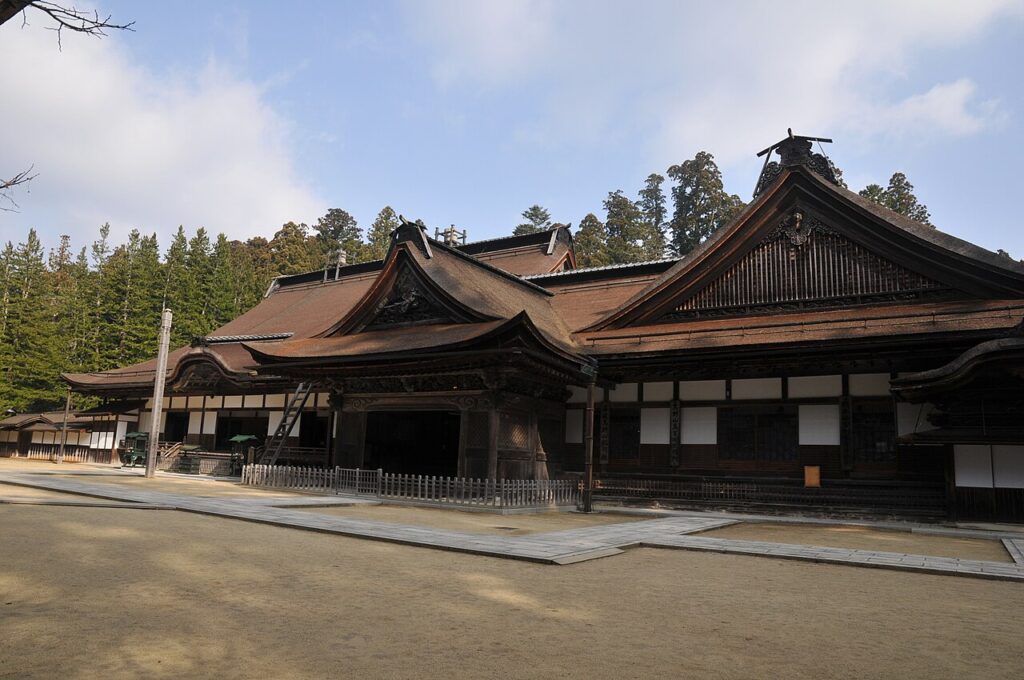
Kongobuji is the head temple of Koyasan Shingon Buddhism. Its grounds contain much more than the rooms and halls of a major religious institution. The impressive Sanmon Gate and Daigenkan entrance reflect the temple’s historical hierarchy, while the Banryutei Rock Garden expresses Buddhist cosmology through carefully arranged stones. Inside, painted fusuma sliding doors reveal the artistic traditions associated with Japanese temple architecture.
Look more closely, however, and other details emerge. A memorial connected with Shinzen Daitoku, an important figure in Koyasan’s early history, recalls the challenges of establishing the Buddhist community. Large wooden tubs on the roof reveal a practical response to the ever-present danger of fire in a mountain settlement filled with wooden buildings.
These details make Kongobuji especially rewarding for travelers who want to understand how religion, architecture, art, and everyday life have shaped Japanese culture over centuries.
1. Kongobuji: The Head Temple of Shingon Buddhism
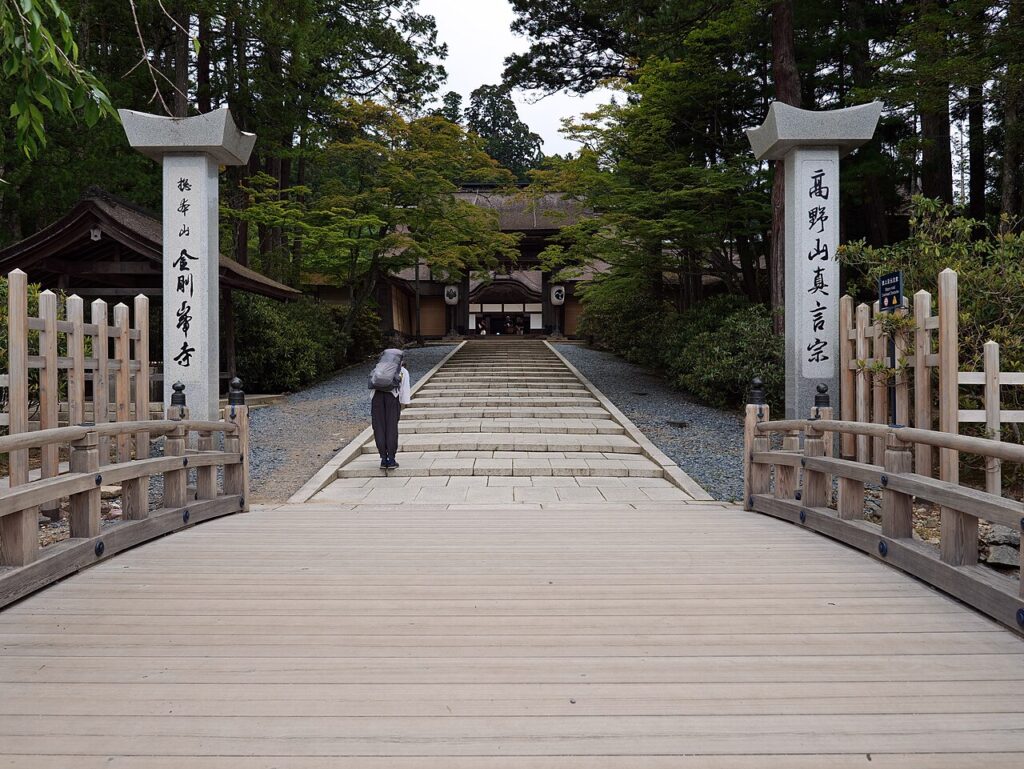
Kongobuji serves as the head temple of Koyasan Shingon Buddhism, a Japanese Buddhist tradition founded by Kobo Daishi, also known as Kukai (774–835).
After studying Buddhism in China, Kukai returned to Japan and developed Shingon, an esoteric Buddhist tradition that places particular importance on ritual, meditation, sacred symbols, and the relationship between the practitioner and the enlightened wisdom of the Buddha.
In 816, Kukai received permission from the imperial court to establish a religious center on Koyasan. The mountain’s remote location, surrounded by forests and peaks, provided an appropriate setting for Buddhist practice away from the political and commercial centers of Japan.
Over the centuries, Koyasan developed into a large religious complex comprising numerous temples, training facilities, and residential communities.
The Kongobuji visitors see today is also the product of a much later historical development. The present temple institution was established in 1869 through the consolidation of two temples, Kozanji and Seiganji. Consequently, it is important to distinguish the history of Kongobuji as an institution from the much older history of Koyasan itself.
This distinction reveals something important about Japanese religious history: sacred places often evolve through the merging, rebuilding, and reorganization of institutions while maintaining their spiritual significance.
Why Is Kongobuji Important?
Kongobuji is not simply a historic building preserved for tourists. It remains the administrative and religious center of Koyasan Shingon Buddhism.
Its significance is therefore both historical and contemporary.
Visitors can admire its architecture and art, but the temple also offers a glimpse into the institutional life of a Buddhist community that has endured for more than a thousand years.
For those exploring Koyasan, Kongobuji provides an essential starting point for understanding the religious tradition that connects the mountain’s temples, pilgrimage routes, and sacred sites.
2. The Sanmon Gate and Daigenkan: Architecture and Religious Hierarchy
One of the most revealing aspects of traditional Japanese temple architecture is the way buildings communicate social and religious status.
At Kongobuji, the Sanmon Gate and the Daigenkan entrance provide an opportunity to explore this relationship.
The Sanmon Gate
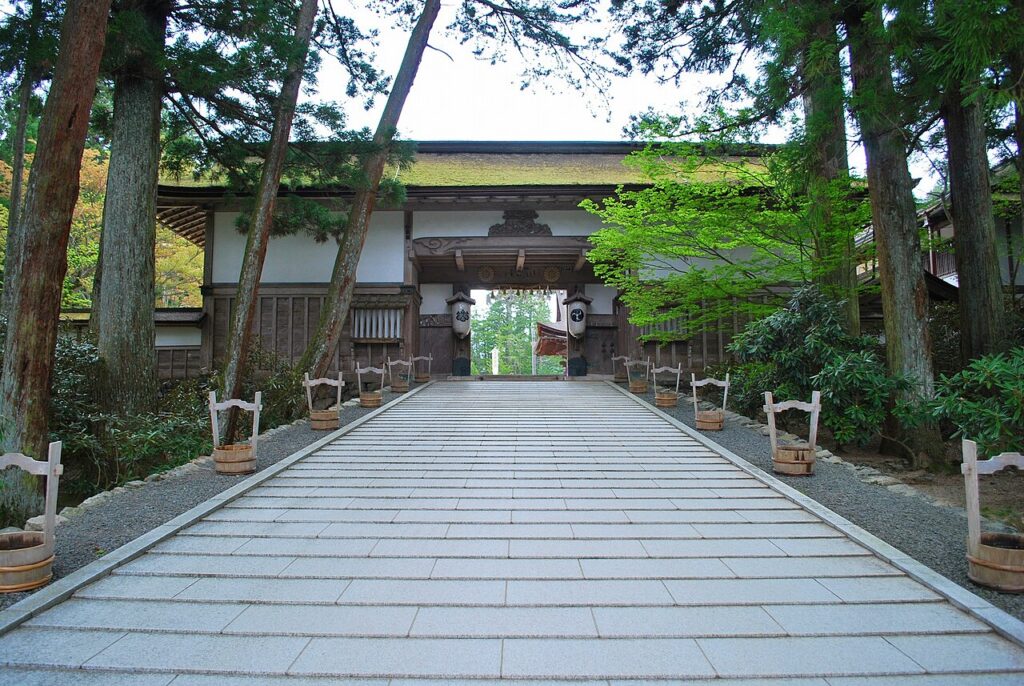
The Sanmon is the temple’s main gate and serves as a symbolic threshold between the outside world and the religious space beyond it.
Traditional temple gates are often more than practical entrances. Their scale, design, and position express the importance of the institution they serve.
At Kongobuji, the Sanmon Gate reflects the prestige and authority of the head temple of Koyasan Shingon Buddhism.
Its historical associations also reveal the hierarchy that once governed access to important religious buildings.
The gate is traditionally associated with the restricted world of the imperial family and high-ranking Buddhist clergy. Access to certain areas of the temple was governed by status, and not everyone could enter through the same doors.
Rather than seeing this simply as an expression of exclusion, it is useful to understand it within the historical structure of Japanese religious institutions, where rank, ritual, and the relationship between Buddhism and the imperial court shaped the use of sacred spaces.
The Daigenkan: An Entrance Reserved for Distinguished Visitors
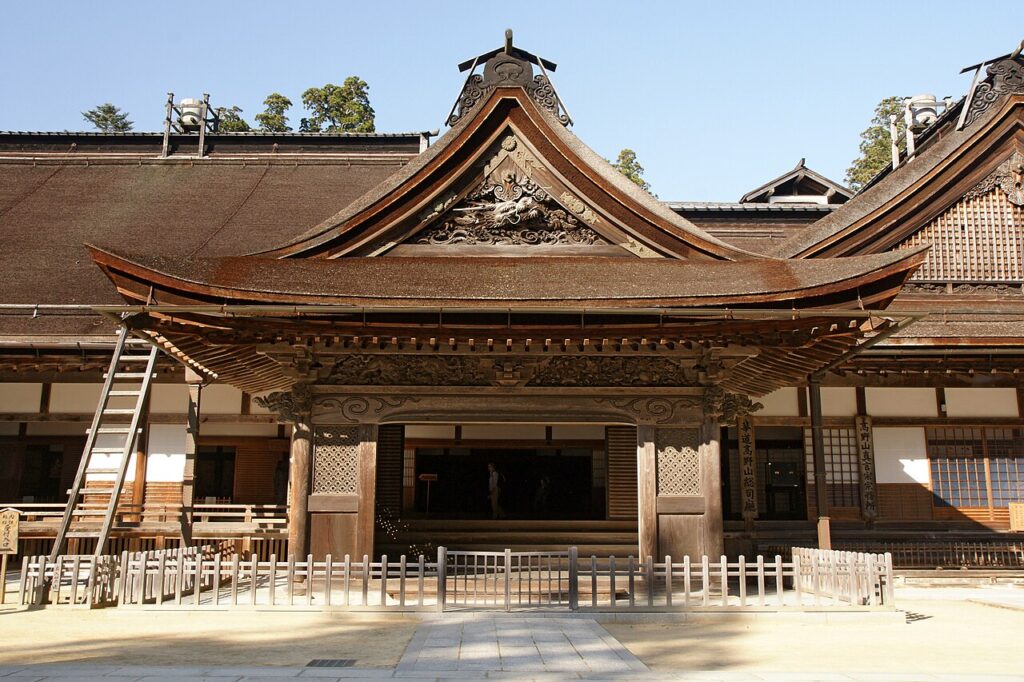
The Daigenkan, or Grand Entrance, is another architectural feature that reveals Kongobuji’s historical standing.
Historically, this entrance was reserved for particularly distinguished visitors, including members of the imperial family and high-ranking Buddhist clergy.
In traditional Japanese architecture, entrances were carefully differentiated according to the status of the people who used them. The route taken into a building could communicate a visitor’s relationship with the institution.
The Daigenkan therefore tells a story that goes beyond its physical appearance. It reflects a world in which religious authority and social hierarchy were expressed through the organization of space.
When visiting, look at the entrance not simply as a doorway, but as part of a broader architectural language.
The building itself communicated who was entitled to approach the temple’s inner world and under what circumstances.
A detail worth noticing: At historic temples, doors and entrances can reveal as much about the social organization of the past as inscriptions or historical documents. Kongobuji is a particularly interesting place to observe this relationship.
Visitor note: The historical use of particular entrances does not necessarily correspond to present-day visitor access. Follow current temple guidance when exploring the grounds.
3. Banryutei Rock Garden: A Dragon Emerging from a Sea of Clouds
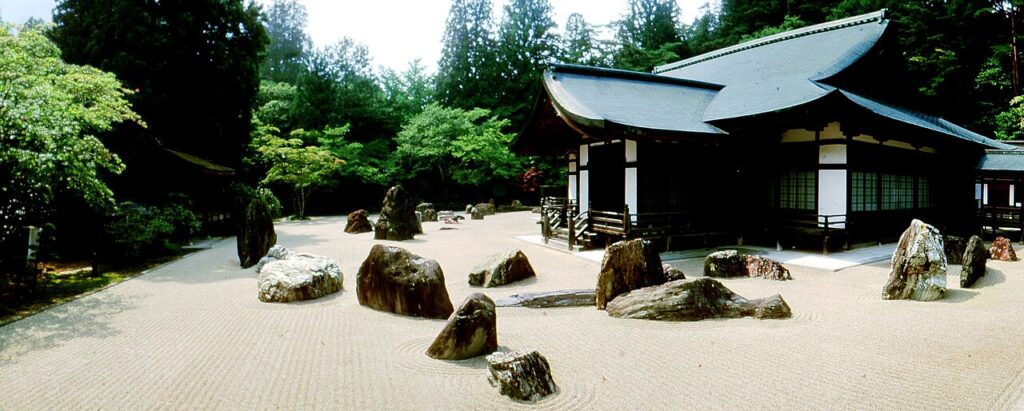
One of Kongobuji’s most celebrated features is Banryutei, a large dry landscape garden (karesansui) created in 1984.
Covering approximately 2,340 square meters, it is widely recognized as one of Japan’s largest rock gardens.
At first glance, the garden appears remarkably simple. White gravel covers the ground, while carefully positioned stones rise from its surface.
Yet the arrangement is intended to evoke a much larger landscape.
The white gravel represents a sea of clouds, while the granite stones form the shapes of dragons. Two dragons appear to emerge from the clouds, facing one another as if protecting the sacred space.
This imagery is especially meaningful at Kongobuji, where the garden’s composition connects the natural world with Buddhist symbolism.
Reading the Garden
Japanese dry landscape gardens often invite visitors to interpret the relationship between empty space and solid form.
In Banryutei, the white gravel is not merely a background for the stones. Its broad, open surface gives the impression of clouds or water, allowing the stone formations to stand out as powerful symbolic figures.
The garden does not attempt to reproduce nature literally. Instead, it reduces the landscape to a small number of carefully arranged elements.
This approach encourages a different way of looking at a garden.
Rather than searching for a single viewpoint or a perfect photograph, take time to observe how the stones relate to one another and how the empty spaces around them shape your perception.
The dragons are not sculpted figures. They emerge through your interpretation of the arrangement.
This is one reason why dry landscape gardens can be experienced as both artistic compositions and invitations to contemplation.
Why Does Banryutei Matter at Kongobuji?
Koyasan’s religious significance is closely connected with the idea of a sacred landscape.
Mountains, forests, ritual spaces, and temple architecture form an interconnected environment in which the natural world is not simply scenery.
Banryutei translates this relationship into a carefully composed garden.
Although the garden is modern rather than an ancient survival, it draws on traditional Japanese garden design to express the spiritual identity of one of Japan’s most important Buddhist centers.
For travelers interested in Japanese gardens, Banryutei offers a useful contrast with famous strolling gardens and landscaped parks. Here, the experience comes from stillness, abstraction, and the interpretation of a limited number of elements.
4. Fusuma Paintings: Art Inside the Temple
Inside Kongobuji, the sliding doors known as fusuma provide another important attraction.
Fusuma are opaque sliding panels traditionally used to divide rooms in Japanese buildings. In temples and aristocratic residences, they often became surfaces for elaborate paintings.
At Kongobuji, painted fusuma connect the architecture of the temple with the artistic traditions of Japan.
Rather than being displayed in separate picture frames, the paintings form part of the building itself. Their scale and placement allow them to interact with the rooms they occupy.
Nature as an Artistic Subject
Among the subjects represented in Kongobuji’s fusuma paintings are landscapes, flowers, and other natural motifs.
These images reflect a long-standing tradition in Japanese art in which nature is used to express beauty, seasonal change, and the relationship between human life and the wider world.
In a temple environment, such paintings also influence the atmosphere of the rooms.
A painted landscape can make an enclosed space feel open. Flowers and trees can bring the changing seasons into an interior setting. The composition of a painting can also affect how a room is perceived as a place for receiving guests, conducting institutional affairs, or engaging in religious life.
The paintings therefore have both artistic and architectural significance.
The Rooms as Part of the Artwork
When viewing the fusuma, notice how the paintings extend across multiple panels and how the sliding doors divide the interior.
Traditional Japanese rooms were designed to be flexible. Moving the panels could change the size and configuration of a space, allowing rooms to serve different purposes.
The paintings were created within this architectural system.
This is quite different from the modern museum experience, where individual artworks are usually separated from their surroundings.
At Kongobuji, the art is inseparable from the building’s history and function.
Take time to appreciate the paintings as part of a larger composition involving the architecture, the room, and the changing views through the open doorways.
Visitor note: Photography restrictions may apply inside the temple. Check the signs and follow staff instructions.
5. Shinzen Daitoku: Remembering the Early History of Koyasan
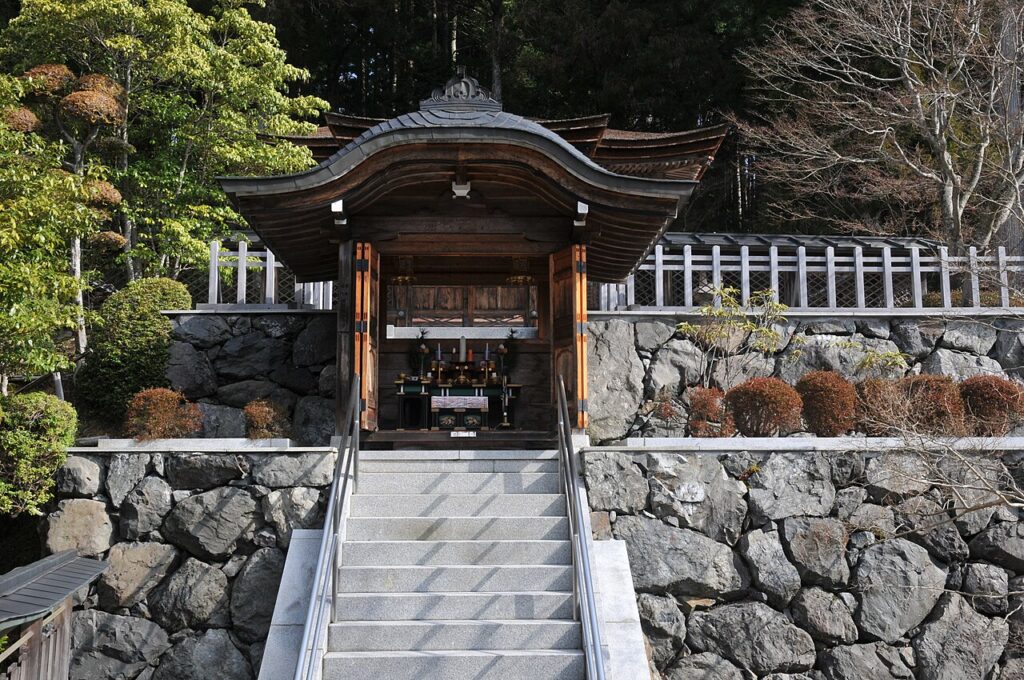
Koyasan’s history is often introduced through Kobo Daishi, but the establishment and continuation of the religious community also depended on other important figures.
One of them was Shinzen Daitoku (真然大徳), a disciple and relative of Kukai who played a significant role in the development of Koyasan after Kukai’s death.
Shinzen helped sustain the religious community and advance the construction and development of its facilities. His work was important during the early period when the mountain’s Buddhist institutions were still taking shape.
His memorial and the traditions associated with his final resting place offer a reminder that the history of Koyasan did not end with its founder.
The People Behind a Sacred Mountain
Founding a religious center in a remote mountain environment required more than spiritual inspiration.
Buildings had to be constructed and maintained. Monks needed places to live and study. Rituals and teachings had to be transmitted across generations.
These activities depended on people who continued the work long after the founder’s lifetime.
Shinzen represents this often-overlooked dimension of Koyasan’s history.
His role helps us understand how a religious center becomes an enduring institution rather than remaining only the vision of a single individual.
For visitors, this provides a valuable perspective on the wider history of Japanese Buddhism.
The sacred character of Koyasan is associated with Kukai, but the mountain’s continuing religious life was shaped by many generations of monks, patrons, builders, and practitioners.
A point to clarify when visiting: Shinzen’s memorial traditions should be distinguished from the better-known belief that Kobo Daishi remains in eternal meditation at Okunoin. They are different elements of Koyasan’s religious history.
6. Wooden Tubs on the Roof: A Practical Response to Fire
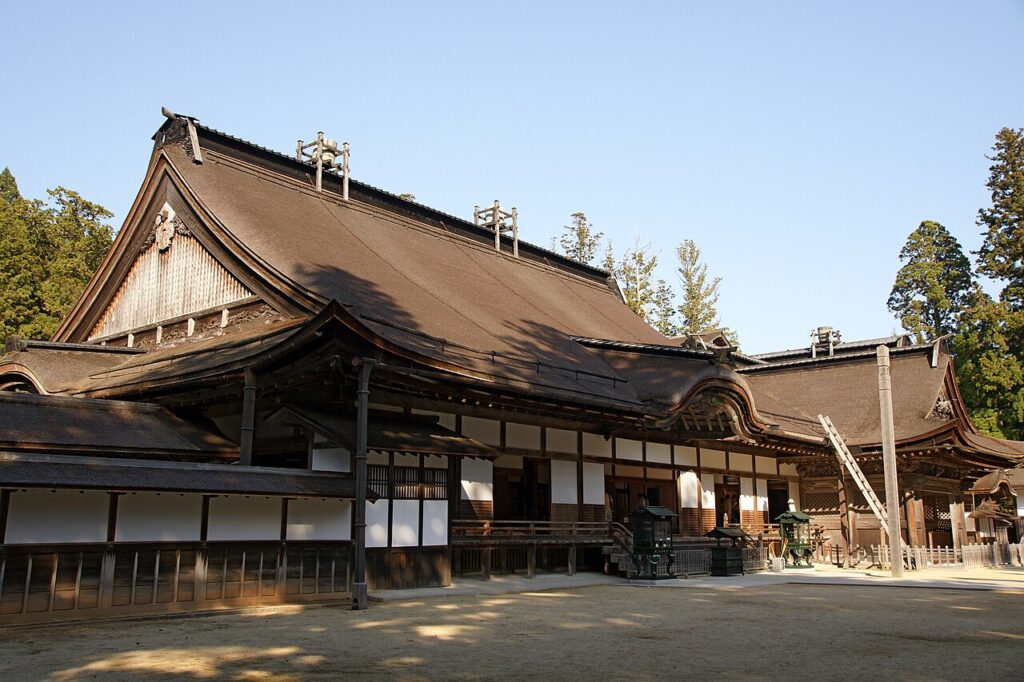
One of the most unexpected details at Kongobuji is found above the building rather than inside it.
Large wooden tubs sit on the roof as a traditional fire-prevention measure.
At first, they may seem out of place on a major Buddhist temple. Yet they reveal an important aspect of life on Koyasan: the need to protect a community whose historic buildings were highly vulnerable to fire.
Living with the Risk of Fire
Traditional Japanese architecture made extensive use of wood, paper, and other combustible materials.
In a dense temple complex, a fire could threaten not just one building but an entire group of religious and residential structures.
Koyasan’s mountain environment added further challenges. Its temples and surrounding forests formed a landscape in which the preservation of buildings required constant attention.
The roof-mounted tubs are associated with the traditional practice of keeping water available as a precaution against fire.
Their presence is a reminder that maintaining a sacred site involved practical knowledge as well as religious devotion.
The people who lived and worked here needed to think about construction, maintenance, water, weather, and the protection of valuable buildings and artworks.
Why This Small Detail Is Worth Noticing
Visitors naturally tend to focus on the most visually impressive features of a historic temple: its gates, gardens, paintings, and ceremonial spaces.
But details such as the roof tubs offer another perspective.
They show how people adapted traditional buildings to the practical challenges of everyday life.
They also provide a useful counterpoint to the idea that historic temples exist outside the ordinary world.
Kongobuji has a profound religious role, but it has also always been a place where people work, maintain buildings, welcome visitors, and preserve a living institution.
Sometimes the smallest architectural details reveal the most about how a place actually functioned.
7. Experiencing Kongobuji Beyond the Main Attractions
Kongobuji can be visited as part of a broader exploration of Koyasan, but it is worth allowing enough time to appreciate its details.
A quick visit focused only on the most famous sights may leave little opportunity to consider how the different elements relate to one another.
Instead, try approaching the temple through several connected themes.
Begin with religious history. Understand the role of Kobo Daishi Kukai and the development of Shingon Buddhism. This provides context for the temple’s importance within Koyasan.
Look at architecture as a social language. The Sanmon Gate and Daigenkan reveal how access, rank, and institutional authority were expressed through buildings.
Spend time with the garden. Banryutei offers an opportunity to consider how stones and empty space can convey a larger landscape and symbolic meaning.
Observe the paintings in their architectural setting. The fusuma paintings are not isolated works of art; they form part of the traditional rooms in which they are displayed.
Look for practical details. The roof tubs remind visitors that preserving a historic temple also required attention to fire prevention and the everyday realities of maintaining wooden buildings.
Taken together, these details provide a richer understanding of Kongobuji than a simple checklist of attractions.
They also suggest a broader way to explore Japanese cultural heritage: by paying attention not only to what a place looks like, but also to how it developed, how it was used, and how people continue to care for it.
8. How to Include Kongobuji in a Koyasan Visit
Kongobuji is an important stop when exploring Koyasan, especially for visitors interested in Buddhism, traditional architecture, and Japanese gardens.
It can be combined with several other significant places on the mountain.
Danjo Garan
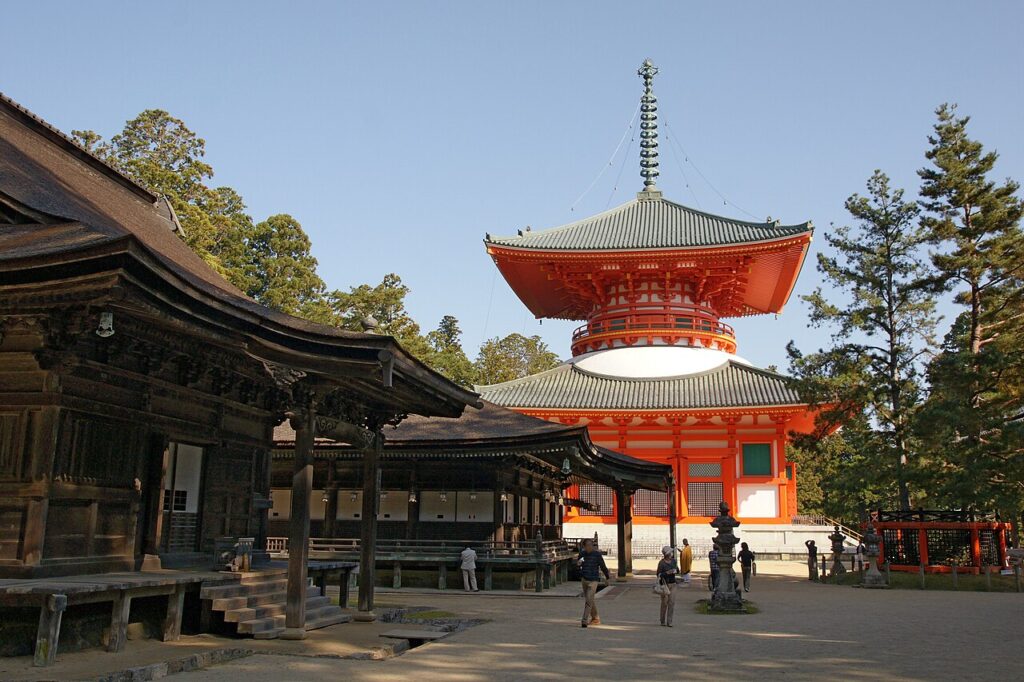
Danjo Garan is one of the central sacred precincts of Koyasan. Its pagoda, halls, and other religious buildings help explain the spatial and symbolic organization of the mountain’s Buddhist center.
Visiting Danjo Garan before or after Kongobuji provides a broader understanding of how Koyasan developed as a religious landscape.
Okunoin Cemetery
Okunoin is one of Japan’s most distinctive sacred places, with a long approach through a forest of towering trees and thousands of memorials.
The atmosphere differs considerably from Kongobuji.
Where Kongobuji introduces visitors to the institutional and artistic dimensions of Koyasan, Okunoin offers a more contemplative experience centered on memorial traditions, Buddhist beliefs, and the continuing presence of Kobo Daishi in Koyasan’s religious life.
Related post: How Okunoin Reflects Japanese Views of Life and Death
The Choishi Michi Pilgrimage Route
For visitors interested in walking, the Choishi Michi is an historic pilgrimage route leading toward Koyasan.
Stone markers along the route help identify distances and guide pilgrims through the mountainous landscape.
Walking even part of a historic pilgrimage route can add an important dimension to a visit, allowing travelers to experience the physical environment through which people have approached this sacred mountain.
The best combination depends on your interests, available time, and walking ability.
For some visitors, the priority will be architecture and gardens. Others may prefer to focus on pilgrimage, forest landscapes, and the religious traditions associated with Okunoin.
Rather than trying to see everything as quickly as possible, consider how these places relate to one another.
Koyasan is not simply a collection of historic attractions. It is a landscape shaped by religious practice, movement through the mountains, and centuries of human activity.
Related post: Walking Choishi-michi: Following the Pilgrims to Koyasan
Frequently Asked Questions About Kongobuji Temple
Is Kongobuji the head temple of Shingon Buddhism?
Yes. Kongobuji is the head temple of Koyasan Shingon Buddhism, a major Japanese Buddhist tradition associated with Kobo Daishi (Kukai).
What is Kongobuji famous for?
Kongobuji is known for its role as the head temple of Koyasan Shingon Buddhism, its Banryutei Rock Garden, traditional fusuma paintings, and historic architecture.
What is the Banryutei Rock Garden?
Banryutei is a large Japanese dry landscape garden at Kongobuji. Its white gravel represents a sea of clouds, while the granite stones are arranged to evoke two dragons emerging from the clouds.
Who was Shinzen Daitoku?
Shinzen Daitoku was an important early figure in Koyasan’s history. A disciple and relative of Kukai, he contributed to the development and continuation of the Buddhist community after Kukai’s death.
Why are there wooden tubs on Kongobuji’s roof?
The tubs are associated with traditional fire-prevention measures. They reflect the importance of protecting wooden buildings in a historic temple complex where fire could cause extensive damage.
How much time should I allow for Kongobuji?
Allow enough time to explore the main rooms, gardens, and architectural details without rushing. Most of the people spend about one hour on the site, but the precise time required depends on your interests and the current visitor arrangements. If you also plan to visit Danjo Garan and Okunoin, consider how much time you want to spend at each site rather than treating the entire mountain as a quick sightseeing stop.
Can I visit Kongobuji and Okunoin on the same day?
Yes. Many visitors explore Kongobuji, Danjo Garan, and Okunoin during the same visit to Koyasan. However, the best schedule depends on your walking pace, transport arrangements, and the time you wish to spend at each location.
Conclusion: Reading the History of Koyasan Through Its Buildings
Kongobuji is one of the most important places to visit on Koyasan, but its significance extends beyond its status as a major Buddhist temple.
Its gardens, paintings, gates, memorial traditions, and practical architectural features reveal different aspects of Japanese religious and cultural history.
Banryutei expresses a symbolic landscape through stones and white gravel. The fusuma paintings demonstrate how art became part of traditional architecture. The Sanmon Gate and Daigenkan reveal the historical relationship between religious institutions and social hierarchy. The memorial traditions associated with Shinzen Daitoku recall the people who helped sustain Koyasan after its founding, while the wooden tubs on the roof reveal the practical concerns involved in preserving a historic mountain community.
Together, these details show that cultural heritage is not just a matter of impressive buildings or famous historical figures.
It is also found in the ways people organized their communities, expressed their beliefs, created works of art, and maintained their surroundings over generations.
For travelers seeking a deeper understanding of Japan, Kongobuji offers an opportunity to look beyond the familiar images of temples and gardens and discover the human history embedded within them.
And when you continue exploring Koyasan, the same approach can reveal new layers of meaning in its pilgrimage routes, forest paths, and sacred precincts.
If you would like to explore Koyasan beyond its most famous sights, a guided walk can help connect its architecture, religious history, and mountain landscape with the wider story of Wakayama. Through a slower approach, the mountain becomes more than a destination: it becomes a place to understand how people have lived with, practiced, and preserved their traditions over centuries.
Explore Koyasan through my Curated Kii Peninsula Journey or contact me.
Related Posts
- 5 Days Around Koyasan: From Koyaguchi and Kudoyama to the Sacred Mountain
- Kūkai: The Monk Who Founded Koyasan and Still Watches Over It
- Beyond Koyasan: Cycling Through the Gateway Towns of Kudoyama and Koyaguchi
- Koyasan & Kumano: The Sacred Network of the Kii Mountains
No responses yet