
Discover Onsen, Plum Landscapes, Pilgrimage Routes, and the Night Sky
When people imagine Shirahama, they often think of beaches, resort hotels, and ocean views.
And while those images are certainly part of the experience, southern Wakayama offers something much deeper.
By staying several days in Shirahama, travelers can gradually discover the cultural landscapes that have shaped life on the Kii Peninsula for centuries.
This is not simply a beach vacation.
It is a journey through mountains, hot springs, agriculture, pilgrimage, and the relationship between people and nature.
Shirahama: Your Base for Exploring Southern Wakayama
For generations, hot springs have been places not only for relaxation, but also for recovery.
The Japanese tradition of toji, or therapeutic hot spring stays, encouraged travelers to remain in one place and allow body and mind to slow down.
Today, Shirahama offers a modern version of that tradition.
Instead of changing hotels every day, travelers can settle into a comfortable rhythm and explore the surrounding region at their own pace.
Related Post:
Beyond the Onsen: A Slow Adventure Stay in Southern Wakayama
The Plum Landscapes of Minabe and Tanabe
A short drive from Shirahama reveals another side of Wakayama.
The hills around Minabe and Tanabe are home to Japan’s most famous plum-growing region.
But these landscapes are more than orchards.
They represent generations of adaptation between people and nature.
Visitors can discover:
- Ume culture and preservation traditions
- Umeshu and local cuisine
- Rural scenery shaped by agriculture
- Seasonal landscapes that change throughout the year
Here, food is inseparable from the land itself.
The story of Wakayama’s plums is also the story of how people have lived with mountains, forests, and limited resources.
Related Post:
Ume Blossom & Rural Landscape in Wakayama
Following the Ancient Pilgrims
Southern Wakayama is also home to the Kumano Kodo pilgrimage routes.
For more than a thousand years, travelers have crossed these mountains in search of spiritual renewal.
Even today, walking a section of the trail offers something increasingly rare:
Time.
Stone paths, cedar forests, village shrines, and quiet valleys create a rhythm that feels very different from modern tourism.
And after a day on the trail, few experiences are more satisfying than returning to a hot spring.
Walking and bathing have always belonged together.
Related Post:
Kumano Kodo Guide: Walking Through Japan’s Living Traditions
Discovering the Mountain Hot Springs of Ryujin
Deeper in the mountains lies Ryujin Onsen.
Long regarded as one of Japan’s famous hot spring areas, Ryujin represents another side of Wakayama.
Here, rivers, forests, and small villages create a peaceful environment far removed from city life.
The journey itself becomes part of the experience.
Travelers often discover that moving slowly between Shirahama, Tanabe, Kumano, and Ryujin reveals connections that are invisible on a map.
Landscapes Shaped by Geological Time
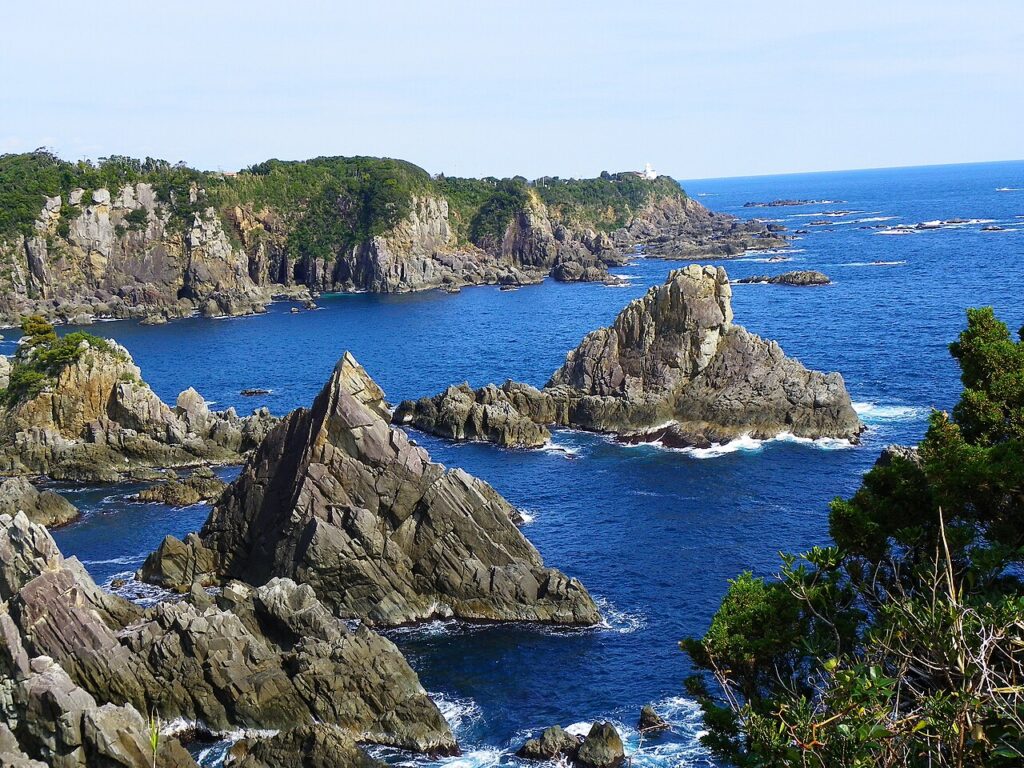
Southern Wakayama is a place where geology becomes visible.
Dramatic coastlines, rock formations, and mountain scenery tell stories written over millions of years.
From the rugged Pacific coast to the interior valleys, the landscape itself becomes a guide to understanding the region.
For travelers interested in photography, nature, or earth history, these places offer endless opportunities for exploration.
Nights Beneath the Stars
When the sun sets, another landscape appears.
Away from the bright lights of major cities, southern Wakayama offers remarkably dark skies.
The mountains and coastline create ideal conditions for:
- Stargazing
- Night photography
- Quiet evening walks
- Simply appreciating the passage of time
After spending the day among mountains, villages, or pilgrimage trails, looking up at the stars becomes a natural conclusion to the journey.
Why Stay Longer?
Southern Wakayama rewards patience.
A single day may show you famous places.
But several days reveal relationships:
- Between mountains and the sea
- Between agriculture and food
- Between pilgrimage and hot springs
- Between geology and human settlement
These connections are what transform a trip into a meaningful journey.
Related Post:
Why Wakayama Is One of Japan’s Best Destinations for Slow Travel
Create Your Own Rhythm
Every traveler experiences Wakayama differently.
Some come for hot springs.
Others for hiking, photography, food culture, or quiet landscapes.
There is no single correct itinerary.
Perhaps that is the greatest luxury of all.
Not seeing everything.
But having enough time to truly experience one place.
Create your own rhythm in Wakayama through Curated Kii Peninsula Journey
No responses yet