
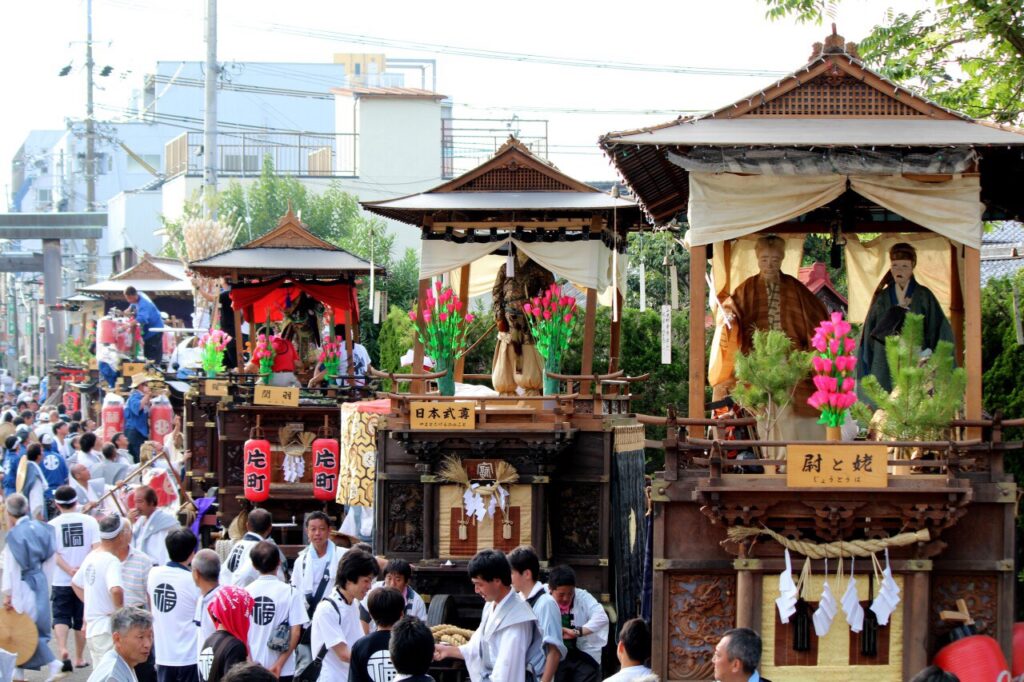
Every summer, the streets of Tanabe transform into one of Wakayama’s most spectacular celebrations. The Tanabe Festival, held on July 24 and 25, is the annual festival of Tokei Shrine and is recognized as one of the Three Great Festivals of Kishu. With a history spanning more than 460 years, it is also designated as an Intangible Folk Cultural Property of Wakayama Prefecture.
Unlike festivals centered solely on entertainment, the Tanabe Festival reflects the identity of the old castle town. Neighborhoods that once formed the merchant districts each prepare and parade beautifully decorated kasaboko (festival floats known locally as okasa). These floats, accompanied by traditional music and local residents in historical attire, fill the streets with a festive atmosphere that has changed remarkably little over the centuries.
Highlights of the Festival
The festival begins on July 24 (Yoimiya) with a sacred procession carrying the portable shrine from Tokei Shrine to the former seaside resting place. As evening falls, the illuminated kasaboko gather at the old Aizu Bridge, where their lanterns reflect beautifully on the river—one of the festival’s most iconic scenes.
On July 25 (Honmatsuri), the day starts before sunrise with the solemn Dawn Ceremony, creating a striking contrast to the lively celebrations later in the day. Throughout the afternoon, the floats parade through the town, while one of the festival’s oldest traditions, the “Seven and a Half Visits” ritual, reenacts the ceremonial meeting of the floats. The festival concludes with yabusame, in which young riders dressed in traditional hunting robes perform horseback archery before the shrine.
Tokei Shrine: A Sacred Gateway to Kumano
Tokei Shrine is much more than the home of the festival. Founded over 1,600 years ago, the shrine was historically regarded as an important center of Kumano worship and served as a substitute place of pilgrimage for those unable to visit the three Kumano Grand Shrines. Because of this role, it is included as part of the UNESCO World Heritage cultural landscape associated with the Sacred Sites and Pilgrimage Routes in the Kii Mountain Range.
The shrine’s name, “Tokei” (“Fighting Cocks”), comes from a famous episode recorded in The Tale of the Heike. Before the Battle of Dan-no-ura, the Kumano leader Tanzo is said to have released red and white fighting cocks to seek divine guidance on whether to support the Taira or Minamoto clan. When the white cocks representing the Minamoto won every match, he decided to join their side, a decision that influenced the outcome of Japanese history.
A Festival That Still Belongs to the Community
What makes the Tanabe Festival especially memorable is the strong involvement of the local community. Each neighborhood takes pride in maintaining its own float, preparing decorations, practicing festival music, and passing traditions from one generation to the next. Visitors are not simply spectators—they are welcomed into a celebration that continues to serve as an expression of local identity.
For travelers exploring the Kumano region, the Tanabe Festival offers an opportunity to experience not only one of Wakayama’s finest traditional festivals, but also the living culture of a town that has long served as the gateway to the sacred Kumano pilgrimage routes.
Read More About Festivals in Wakayama
- The Spirit of Kokawa Festival
- Dancing Through a Wakayama Summer Night
- The Wakamatsuri Festival: A 400-Year Legacy of the Kishu Tokugawa Family
No responses yet